Author: Legacy Vanguard Scott Group

  • Boost Your Team’s Accountability Instantly with These 5 Veteran-Led Presence Tips

    Boost Your Team’s Accountability Instantly with These 5 Veteran-Led Presence Tips

    In high-stakes environments, accountability isn’t a suggestion: it’s a survival mechanism. At Legacy Vanguard Scott Group (LVSG), we’ve seen how the absence of clear ownership can cripple even the most talented teams. Organizations often struggle with persistent vacancies, lackluster supervision, and a culture of "passing the buck."

    To solve these challenges, we draw from the rigorous discipline of military service and translate it into a high-performance "operating system" for the civilian sector. True accountability starts with Presence. This isn’t about being the loudest person in the room; it’s about projecting clarity, modeling standards, and instilling a sense of purpose that empowers your team to execute with precision.

    As part of our Executive Excellence Series, we are sharing five veteran-led tips to sharpen your leadership presence and harden your organization’s culture of accountability.


    1. Define the Commander’s Intent (Strategic Alignment)

    In the military, "Commander’s Intent" is a clear, concise statement of what the mission must achieve and why. It’s the "north star" that allows subordinates to make independent decisions when the situation changes on the ground. In a corporate setting, we call this Strategic Alignment.

    If your team is constantly asking for permission or waiting for instructions, you haven't established a clear intent.

    The Veteran-Led Move:
    Stop micro-managing the "how" and start over-communicating the "what" and the "why." When you assign a project, explicitly state the desired end-state.

    • Civilian Translation: "The mission this supports is [Strategic Objective]. If we succeed, the impact on our organization is [Measurable Outcome]."

    When your team understands the mission’s purpose, they take ownership of the results. This is the foundation of veteran-led leadership training.

    2. Establish an Operational Rhythm (Battle Rhythm)

    Chaos thrives in a vacuum. Without a predictable cadence of communication, accountability slips through the cracks. The military uses a "Battle Rhythm": a disciplined schedule of briefings and reports: to maintain momentum. For business leaders, this is your Operational Rhythm.

    A structured rhythm ensures that every team member knows when they are expected to report progress and where the bottlenecks are. It eliminates the "I didn't know that was due" excuse.

    A Hispanic female executive leading a disciplined standing meeting, illustrating a structured operational rhythm.

    The Veteran-Led Move:
    Implement a "Sync Matrix" or a fixed meeting cadence that focuses solely on status, blockers, and decisions.

    • Daily Stand-ups: 15 minutes to align on the day's objectives.
    • Weekly Command Reviews (Executive Summaries): A deeper dive into KPIs and resource allocation.

    By protecting this time, you signal that accountability is a non-negotiable part of the organization’s DNA.


    3. Master the Strategic Debrief (After-Action Review)

    Accountability isn't just about looking forward; it's about looking back with radical honesty. The military utilizes the "After-Action Review" (AAR) after every mission to analyze what happened, why it happened, and how to improve. In the private sector, we call this a Strategic Debrief.

    Too many companies skip the debrief to rush into the next project. This ignores valuable data and allows the same mistakes to repeat.

    A diverse corporate team conducting a Strategic Debrief (AAR), analyzing data and collaborating on improvements.

    The Veteran-Led Move:
    After every major milestone, facilitate a session where seniority is checked at the door. Ask four questions:

    1. What was supposed to happen?
    2. What actually happened?
    3. Why was there a difference?
    4. What will we do differently next time?

    This process builds trust and ensures that leadership development consulting is rooted in real-world performance, not just theory.

    4. Hardcode Decision Rights (Authority and Lanes)

    Accountability dies in the "gray space" where no one is sure who has the final say. In military units, every person knows their "lane": their specific area of responsibility and the authority that comes with it. In business, you must define Decision Rights.

    If your managers feel they have the responsibility but not the authority to act, they will stop trying. This leads to the "supervision challenges" we often see in growth-stage employers.

    A Black male mentor providing direct feedback to a colleague, embodying presence and the reinforcement of decision-making authority.

    The Veteran-Led Move:
    Use a "Decision Rights Matrix" to clarify roles. For every major function, identify:

    • The Owner: Who has the "D" (Decision) right?
    • The Contributors: Who must be consulted?
    • The Informed: Who needs to know the outcome?

    When people own their lanes, they own their outcomes. This is a core component of effective management coaching and training.


    5. Lead from the Front (Personal Accountability)

    The most powerful tool in a leader's arsenal is their own behavior. In the military, leaders "lead from the front," meaning they never ask a subordinate to do something they aren't willing to do themselves. In your organization, this means modeling the high standards you expect from others.

    If you are late to meetings but demand punctuality, or if you hide from bad news but demand transparency, you have already lost your "command presence."

    Hands of a diverse team stacked together, symbolizing unity and shared accountability modeled by leadership.

    The Veteran-Led Move:
    Practice "Extreme Ownership." When a goal is missed, your first question should be, "What did I fail to provide or communicate that led to this result?"

    By taking responsibility for the team's failures, you earn the right to celebrate their successes. This authentic presence creates a culture where employees feel safe to own their mistakes and motivated to exceed expectations.

    Building Your Legacy

    At Legacy Vanguard Scott Group, we believe that leadership is a disciplined practice, not a personality trait. By integrating these veteran-led techniques: Strategic Alignment, Operational Rhythm, Strategic Debriefs, and Clear Decision Rights: you can transform your team into a high-performance engine capable of achieving breakthrough results.

    Improving leader behavior and hiring operations isn't just about the bottom line; it's about protecting the quality of your service and the integrity of your brand.

    Who’s ready to harden their culture and build a legacy? 🔥 🌐 https://www.legacyvanguardscott.com/ 🌐
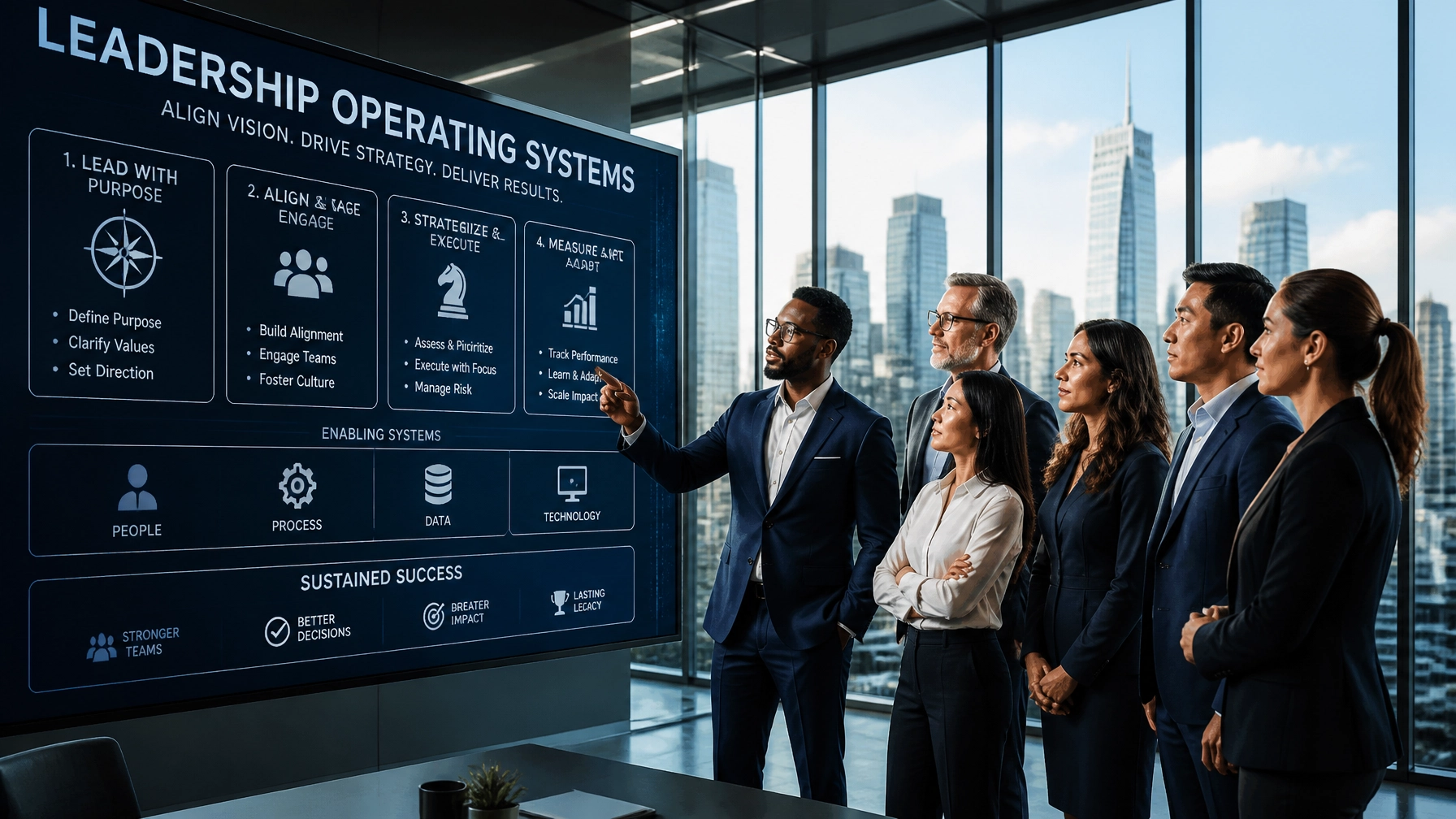
  • 7 Mistakes You’re Making with Your Leadership Operating System

    7 Mistakes You’re Making with Your Leadership Operating System

    A Leadership Operating System (LOS) is the invisible architecture that dictates how an organization breathes, moves, and scales. It is not a collection of buzzwords or a static handbook gathering dust on a digital shelf: it is a living framework of behaviors, decision rights, and communication protocols. When executed with precision, an LOS creates an environment of high accountability and predictable results. When mismanaged, it becomes a source of friction that erodes trust and stifles growth.

    At Legacy Vanguard Scott Group (LVSG), we specialize in hardening these systems through a dual-service model that bridges the gap between top-tier leadership and a robust, auditable staffing engine. We have observed that even the most ambitious organizations often stumble over the same foundational hurdles.

    Here are the seven critical mistakes you are making with your Leadership Operating System and how to ignite a transformation that lasts.

    1. Fragmented Strategic Alignment (Commander’s Intent)

    The most common point of failure in any LOS is the absence of clear Strategic Alignment (Commander’s Intent). In a military context, Commander’s Intent provides a clear picture of what success looks like, allowing subordinates to exercise disciplined initiative even when the original plan falls apart.

    In the corporate sector, leaders often fail to translate their high-level vision into a concrete, shared understanding of the end-state. If your team cannot articulate the "why" and the "what" of your current mission without checking a slide deck, you have a fragmented system. This disconnect leads to wasted effort: teams working hard in directions that do not move the needle. You must empower your leaders to lead with confidence by ensuring every action is anchored to a unified strategic purpose.

    Diverse group of leaders engaged in a strategic alignment session

    2. A Broken Operational Rhythm (Rhythm of Battle)

    Consistency is the bedrock of discipline. Many organizations suffer from a chaotic Operational Rhythm (Rhythm of Battle): the cadence of meetings, reports, and decision-making cycles that keep the organization synchronized.

    A broken rhythm manifests as meetings that have no clear agenda, inconsistent attendance, or a lack of follow-through on action items. To strengthen your LOS, you must establish a rigorous cadence that facilitates the flow of information upward and downward. Without a disciplined operational rhythm, your leadership team remains reactive, constantly putting out fires instead of preventing them. High-impact organizations treat their meeting cadence as a sacred "operating system" component that cannot be compromised.

    Diverse team synchronized in a workspace representing operational rhythm

    3. Viewing Executive Coaching for Leaders as a Luxury

    Many executives believe they can implement a complex LOS without external perspective. They view executive coaching for leaders as a remedial measure or a "nice-to-have" for underperformers. This is a strategic error.

    The most effective leaders utilize personalized 1:1 coaching to identify blind spots in their own behavior and to refine their decision-making processes. An LOS is only as effective as the leaders who operate it. By investing in top-tier executive coaching, you ensure that your leadership behaviors align with the system you are trying to build. This investment results in measurable behavior change: connecting your personal growth directly to the organization’s bottom line.

    A personalized 1:1 executive coaching session between a coach and executive

    4. Skipping the Strategic Debrief (After Action Review)

    Growth requires a feedback loop. In high-stakes environments, the Strategic Debrief (After Action Review, or AAR) is a non-negotiable tool for continuous improvement. It is a disciplined process of looking at what was supposed to happen, what actually happened, and why.

    Too often, business leaders finish a project or a quarter and immediately sprint to the next objective without a formal debrief. This mistake ensures that the same errors are repeated and successes are never fully codified into the system. A robust LOS must include a culture of accountability where every significant action is followed by a strategic debrief to capture lessons learned and refine the operating system.

    Diverse team of executives conducting a strategic debrief

    5. Neglecting Management Coaching and Training

    An LOS often fails because it is only embraced at the "Apex" level. If your mid-level managers are not equipped to model and enforce the new ways of working, the system will collapse. Management coaching and training is the bridge that carries the LOS from the boardroom to the front lines.

    Your managers are the primary drivers of culture and retention. Without a "custom-tailored" training program that aligns their skills with the company's operating system, they become unintentional bottlenecks. To achieve breakthrough performance, you must empower every level of management with the tools to lead with authority and clarity.

    6. Designing Around Personalities, Not Performance

    A major pitfall in leadership development is building processes around the specific quirks or preferences of individual leaders rather than the objective needs of the business. When an LOS is personality-dependent, it becomes fragile. If a key leader leaves, the system breaks.

    An "operating system" mindset requires you to define roles, decision rights, and responsibilities based on the organizational mission. By standardizing these elements, you create a resilient structure that survives leadership transitions. This approach creates an air of exclusivity and premium service within your own ranks, as everyone understands exactly what is required to excel in their role.

    7. Failing to Integrate the Staffing Engine

    A Leadership Operating System cannot exist in a vacuum. It must be fueled by a strategic recruiting and staffing engine that brings in "culture-aligned" talent.

    Many firms make the mistake of separating their leadership standards from their hiring operations. At LVSG, our dual-service model ensures that your staffing engine is auditable and integrated directly into your leadership framework. If you are hiring people who do not fit the discipline and rigor of your LOS, you are effectively introducing a virus into your operating system. Stabilizing your staffing is the first step toward protecting your service quality and building a lasting legacy.

    Elevate Your Leadership Performance

    Correcting these mistakes requires more than just a quick fix; it requires a commitment to high standards and a purpose-driven strategy. Whether you are looking to harden your culture or optimize your hiring operations, the time to act is now.

    Your legacy is defined by the systems you leave behind. Don't settle for a fragmented approach: demand a Leadership Operating System that delivers measurable results.

    Who’s ready to harden their culture and build a legacy? 🔥 🌐 https://www.legacyvanguardscott.com/ 🌐

  • Does Executive Coaching Really Matter in 2026?

    Does Executive Coaching Really Matter in 2026?

    ![A diverse group of modern executives: Black, White, Hispanic, and Asian men and women: collaborating in a high-tech, sunlit boardroom overlooking a futuristic 2026 city skyline. They are reviewing holographic data charts while maintaining strong, authoritative, and engaged body language, symbolizing high-level leadership and strategic alignment.](https://image.pollinations.ai/prompt/A%20diverse%20group%20of%20modern%20executives: Black,%20White,%20Hispanic,%20and%20Asian%20men%20and%20women: collaborating%20in%20a%20high-tech,%20sunlit%20boardroom%20overlooking%20a%20futuristic%202026%20city%20skyline.%20They%20are%20reviewing%20holographic%20data%20charts%20while%20maintaining%20strong,%20authoritative,%20and%20engaged%20body%20language,%20symbolizing%20high-level%20leadership%20and%20strategic%20alignment.?width=1280&height=720&nologo=true)

    The year 2026 has arrived with a relentless operational tempo: the speed and intensity of business operations: that would have been unimaginable just five years ago. We are living in an era where Artificial Intelligence (AI) can draft a strategic plan in seconds, automate entire hiring workflows, and predict market shifts with unsettling accuracy.

    In this landscape of hyper-automation, a critical question echoes through boardrooms from the DMV region to Silicon Valley: Does executive coaching still matter?

    If an algorithm can optimize your supply chain and a chatbot can handle your customer service, do you really need a human advisor to refine your leadership?

    The answer is a resounding yes. In fact, as we navigate the complexities of 2026, executive coaching for leaders has moved from a "luxury development tool" to a mission-critical operating system: the fundamental organizational framework: for any firm that intends to survive and build a lasting legacy. At Legacy Vanguard Scott Group (LVSG), we see it every day: the higher the tech, the higher the need for human discipline, high-level judgment, and Strategic Alignment (Commander’s Intent).

    The 2026 "Human Premium": Beyond the Algorithm

    In 2026, AI is a commodity. Every one of your competitors has access to the same large language models and predictive analytics. Technology is no longer the differentiator; leadership is. We call this the "Human Premium."

    While AI can process data, it cannot navigate the nuanced terrain of organizational politics, ethics, or the complex emotional architecture of a diverse workforce. Executive leadership development programs are now designed to sharpen the one tool AI cannot replicate: high-stakes decision-making under pressure.

    Strategic Alignment (Commander’s Intent)

    In military operations, we rely on Commander’s Intent: the clear, concise expression of the purpose of the operation and the desired end state. In the private sector, we translate this as Strategic Alignment.

    When a leader is coached to communicate Strategic Alignment effectively, they empower their teams to act autonomously even when the "battlefield" of the market changes. AI cannot provide this. It can give you a map, but it cannot give your team the will to march or the clarity to pivot when the map becomes obsolete. Coaching ensures that your leadership voice remains the steady frequency in a world of digital noise.

    ![An abstract, high-impact visual representing 'Strategic Alignment'. A central glowing core of light: representing the leader's vision: radiates outward, aligning various geometric shapes and data streams into a cohesive, forward-moving vector. The aesthetic is professional, disciplined, and futuristic, utilizing deep blues and gold accents.](https://image.pollinations.ai/prompt/An%20abstract,%20high-impact%20visual%20representing%20'Strategic%20Alignment'.%20A%20central%20glowing%20core%20of%20light: representing%20the%20leader's%20vision: radiates%20outward,%20aligning%20various%20geometric%20shapes%20and%20data%20streams%20into%20a%20cohesive,%20forward-moving%20vector.%20The%20aesthetic%20is%20professional,%20disciplined,%20and%20futuristic,%20utilizing%20deep%20blues%20and%20gold%20accents.?width=1024&height=576&nologo=true)

    The ROI of Precision Leadership

    The skeptics of the past often viewed coaching as "soft." In 2026, the data has silenced that argument. Organizations that invest in leadership development consulting see a measurable impact on their bottom line.

    Current industry benchmarks indicate that well-structured executive coaching delivers a 5x to 7x return on investment (ROI). How does this manifest?

    • Reduced Regretted Attrition: High-level coaching directly correlates with improving organizational culture. When leaders are more self-aware and disciplined, they create environments where top talent stays.
    • Operational Rhythm (Rhythm of Battle): Coaching helps executives establish a consistent Operational Rhythm: the synchronized cadence of meetings, reporting, and decision-making. This discipline eliminates "drag" and ensures that the organization moves at the speed of the 2026 market.
    • Measurable Behavior Change: Unlike a one-off seminar, 1:1 coaching at LVSG focuses on auditable results. We don't just talk about leadership; we harden the behaviors that drive revenue.

    The LVSG Dual-Service Model: Coaching Meets Staffing

    At Legacy Vanguard Scott Group, we recognize that leadership does not exist in a vacuum. You can be the most enlightened executive in the world, but if your "staffing engine" is broken, you are simply a general without an army.

    This is why our services link executive coaching with a structured, auditable staffing engine. In 2026, the labor market is tighter than ever. Veteran-owned firms like ours understand that recruitment is a strategic operation. By coaching the leaders and optimizing the hiring process, we ensure that your organization has both the "heads" and the "hearts" required to win.

    We target organizations: particularly in healthcare and the public sector: facing persistent vacancies. Our approach isn't just about filling seats; it's about improving organizational culture so that those seats stay filled. A leader who has undergone a rigorous coaching program is better equipped to manage the "human capital" we provide, creating a virtuous cycle of stability and growth.

    The Strategic Debrief (After Action Review): A 2026 Necessity

    In the fast-paced 2026 business cycle, most leaders make a mistake: they finish one project and immediately sprint to the next. This is a failure of discipline.

    Elite leaders utilize the Strategic Debrief (After Action Review or AAR). This is a structured process to analyze what happened, why it happened, and how it can be done better next time.

    Executive coaching provides the external accountability needed to maintain this Strategic Debrief cycle. A coach acts as a "battle buddy": a trusted peer and accountability partner: who forces you to pause, reflect, and extract the "lessons learned" from every engagement. This process is what transforms a simple "win" into a repeatable, scalable process. It is the difference between a lucky quarter and a lasting legacy.

    Hardening Your Culture for the Future

    As we look toward the remainder of 2026 and beyond, the role of the executive is shifting. You are no longer just a "manager of tasks"; you are the architect of an operating system.

    Your culture is that operating system. If it is buggy, slow, or prone to crashing under pressure, no amount of AI integration will save you. Executive coaching for leaders is the "software update" your culture needs. It empowers you to:

    1. Ignite a sense of purpose within your teams.
    2. Elevate the standards of performance across the board.
    3. Strengthen the bonds of trust that allow for rapid execution.

    The organizations that will be remembered in 2030 are those that started building their legacy today. They are the ones that realized that while machines can calculate, only leaders can inspire.

    ![A wide-angle shot of a diverse team: Asian, White, and Black professionals: standing together on a rooftop terrace in the DMV region. They are looking toward a bright horizon, symbolizing vision and long-term legacy. The lighting is warm and empowering, reflecting a 'purpose-driven' and 'culture-aligned' organizational outcome.](https://image.pollinations.ai/prompt/A%20wide-angle%20shot%20of%20a%20diverse%20team: Asian,%20White,%20and%20Black%20professionals: standing%20together%20on%20a%20rooftop%20terrace%20in%20the%20DMV%20region.%20They%20are%20looking%20toward%20a%20bright%20horizon,%20symbolizing%20vision%20and%20long-term%20legacy.%20The%20lighting%20is%20warm%20and%20empowering,%20reflecting%20a%20'purpose-driven'%20and%20'culture-aligned'%20organizational%20outcome.?width=1024&height=576&nologo=true)

    Secure Your Legacy

    The complexity of 2026 demands a higher level of leadership. You cannot solve today’s challenges with yesterday’s mindset. Whether you are a veteran-owned small business or a growth-stage employer in the healthcare sector, the time to harden your leadership is now.

    At Legacy Vanguard Scott Group, we provide the military-inspired rigor and the corporate-aligned strategy needed to achieve breakthrough performance. Our executive coaching intake form is the first step toward transforming your leadership from a functional role into a powerful legacy.

    Who’s ready to harden their culture and build a legacy? 🔥 🌐 https://www.legacyvanguardscott.com/ 🌐

  • Executive Coaching Secrets Revealed: What Experts Don’t Want You to Know About Navigating Complexity

    Executive Coaching Secrets Revealed: What Experts Don’t Want You to Know About Navigating Complexity

    The leadership development industry is saturated with "soft" solutions that crumble the moment they encounter real-world friction. In high-stakes environments: healthcare systems facing critical shortages, public-sector agencies under intense scrutiny, or growth-stage companies scaling at breakneck speed: generic advice isn't just useless; it’s a liability.

    Most executive leadership development programs focus on the "what" and "how" of management but ignore the foundational "operating system" that governs a leader’s ability to execute under pressure. At Legacy Vanguard Scott Group (LVSG), we believe it’s time to pull back the curtain.

    Here is the truth about executive coaching for leaders that most experts won’t tell you: real transformation isn't about learning new "tricks." It’s about hardening your organizational culture through discipline, mission-driven rigor, and measurable behavior change.

    The Myth of the "Event-Based" Transformation

    The biggest secret in the industry is that most management coaching and training is designed for the comfort of the participants, not the success of the organization. Companies spend billions on weekend retreats and one-off seminars, hoping for a breakthrough that never comes.

    Why? Because leadership is not an event; it is an Operational Rhythm (Rhythm of Battle).

    In complex environments, the "fog of war": or the chaos of daily operations: quickly obscures the lessons learned in a quiet classroom. Effective coaching must be embedded into the actual workflow. It requires a "Translation Layer" that takes high-level strategy and converts it into Frontline Execution (Boots on the Ground). Without this layer, your leadership development is merely a line item on a budget, not a driver of ROI.

    A diverse group of healthcare executives: a Black woman, a White man, and a Hispanic woman: in professional attire, standing in a brightly lit, modern hospital corridor. They are looking at a tablet together, discussing strategy with serious, focused expressions. The setting conveys a sense of urgency and high-level decision-making in a healthcare environment.

    Secret 1: Strategic Alignment Over "Empowerment"

    In the corporate world, "empowerment" is often a code word for a lack of direction. Leaders tell their teams to "take initiative," but without Strategic Alignment (Commander’s Intent), that initiative often leads to Scope Creep (Mission Creep).

    The secret to navigating complexity is providing a clear, auditable framework for decision-making. At LVSG, we teach leaders to communicate the why so clearly that the how becomes a matter of professional discipline for their teams. This creates a "trust but verify" environment where Decision Rights are clearly defined, and leaders are free to focus on high-level strategy rather than micromanaging the minutiae.

    Secret 2: The Non-Negotiable Strategic Debrief

    Most organizations move from one crisis to the next without ever pausing to analyze what actually happened. They mistake "activity" for "achievement."

    The most powerful tool in our arsenal is the Strategic Debrief (AAR: After Action Review). Experts won't tell you this because it's difficult and requires radical transparency. It’s a disciplined process of asking:

    • What was supposed to happen?
    • What actually happened?
    • Why was there a gap?
    • What will we change next time?

    When this becomes a part of your organization's Operating System, you stop making the same expensive mistakes. You transition from a reactive posture to a proactive, "apex" level of performance.

    An intense but professional

    Secret 3: Relational Intelligence is a Hard Skill

    The industry often treats "soft skills" like empathy and communication as optional extras. In reality, Relational Intelligence is the bedrock of Strategic Recruiting and retention.

    In growth-stage companies or the public sector, where resources are often stretched thin, the ability to build high-trust teams is a competitive advantage. You cannot "engineer" a legacy; you have to lead people into one. This involves:

    • Active Listening: Identifying the underlying "pain points" of your staff before they become resignation letters.
    • Culture-Aligned Hiring: Using a structured, auditable staffing engine to ensure every new hire strengthens the collective "armor" of the team.
    • Executive Presence: Maintaining a "calm in the storm" demeanor that ignites confidence in others.

    Secret 4: Hardening the Culture to Protect the Mission

    Complexity thrives in environments with weak standards. Many executive leadership development programs fail because they are too afraid to demand excellence. They prioritize being "liked" over being "effective."

    True executive coaching for leaders focuses on hardening the culture. This doesn't mean being "tough" for the sake of it; it means having the courage to uphold high standards even when it’s uncomfortable. It means eliminating the "lost productivity" that comes from vague meeting cadences and undefined roles.

    When you harden your culture, you create a shield that protects your team from the burnout and chaos inherent in the healthcare and public sectors. You move from surviving complexity to mastering it.

    A 1:1 executive coaching session between an older Black man (the coach, with a veteran's poise) and a younger Hispanic woman executive. They are sitting in a premium, quiet office with a view of a city skyline. The coach is gesturing with his hands, explaining a concept, while the executive takes notes. The atmosphere is one of mentorship, respect, and serious development.

    Secret 5: Legacy is the Ultimate Metric

    The final secret is that the best coaches aren't looking for a long-term contract; they are looking to build a self-sustaining leader. The goal of any custom-tailored program should be to make the coach obsolete by installing a permanent Operating System of leadership within the organization.

    At Legacy Vanguard Scott Group, we don’t just offer "advice." We provide a dual-service model that links executive leadership coaching with a structured, auditable staffing engine. We help you find the right people and then give you the tools to lead them to breakthrough performance.

    Complexity isn't a problem to be solved; it’s a reality to be navigated with discipline, clarity, and a commitment to a lasting impact.

    A symbolic image of

    Whether you are a veteran-owned small business, a healthcare executive, or a public sector director, the path to the "Apex" of your potential begins with a simple question: Are you ready to stop managing and start leading?

    The secrets are out. The question is, what will you do with them?

    Who’s ready to harden their culture and build a legacy? 🔥 🌐 https://www.legacyvanguardscott.com/ 🌐

  • 7 Mistakes You’re Making with Management Coaching in Complex Environments

    7 Mistakes You’re Making with Management Coaching in Complex Environments

    In high-stakes industries: healthcare, public sector, and rapid-growth technology: leadership is not merely a title; it is an operating system. When that system fails, the repercussions ripple through every layer of the organization, leading to persistent vacancies, eroded service quality, and a culture of reactive firefighting.

    At Legacy Vanguard Scott Group, we see many organizations attempt to solve these issues with management coaching. However, standard coaching models often crumble when applied to complex, volatile environments. Without a foundation of discipline and strategic rigor, coaching becomes a superficial "fix" rather than a catalyst for transformation.

    To harden your culture and ensure your leaders are equipped for mission success, you must avoid these seven critical coaching mistakes.


    1. Operating as a “Fixer” Instead of a Coach

    The most common failure in executive leadership coaching is the transition from advisor to "fixer." In high-pressure environments, the urge to provide immediate solutions is strong. However, when a coach jumps in to solve a problem: directing the coachee’s next move: they inadvertently weaken the leader’s autonomy.

    This directive approach reinforces dependency. Instead of building a leader capable of Empowered Execution (Mission Command), you create a manager who waits for permission. Professional coaching should ignite critical thinking, not provide a script. At LVSG, our Elevate and Apex coaching tiers focus on asking the high-impact questions that force executives to navigate their own strategic landscape.

    2. Treating Coaching as Crisis Repair Only

    Many organizations only deploy coaching when a leader is failing or a department is in disarray. This "ambulance at the bottom of the cliff" approach is a tactical error. Coaching should not be a punitive tool; it is a proactive developmental engine.

    When coaching is reserved for crisis repair, it loses its power to drive long-term Strategic Alignment (Commander’s Intent). True leadership excellence requires a consistent, disciplined investment in "being" as much as "doing." If you are only coaching during a crisis, you are perpetually behind the Operational Rhythm (Rhythm of Battle).

    A conceptual visualization of a structured Leadership Operating System, representing order and organizational stability.

    3. Ignoring the "Complexity Gap" and Systemic Factors

    In complex environments like healthcare, problems are rarely isolated to a single individual. A mistake many coaches make is treating a performance issue as a personality flaw while ignoring the broken Operating System surrounding the leader.

    If your coaching doesn't account for chronic understaffing, conflicting Decision Rights, or inefficient workflows, it will fail. Effective coaching must bridge the "Complexity Gap": the space between a leader’s current capability and the escalating demands of their environment. We integrate a structured, auditable staffing engine with our coaching to ensure that leadership growth is supported by organizational stability.

    4. Failing to Establish a Clear Strategic Alignment (Commander’s Intent)

    Without a clear Strategic Alignment (Commander’s Intent), coaching sessions become aimless conversations. Leaders in complex environments need to know exactly what success looks like: not just for their task, but for the entire organization’s legacy.

    Coaching must be tethered to measurable behavior change and organizational outcomes. If the coach and the coachee are not aligned on the "why" behind the development, the results will be ephemeral. Discipline dictates that every session must move the needle toward a defined strategic objective.

    A seasoned mentor listening intently to a younger healthcare executive during a professional coaching session.

    5. Neglecting the Operational Rhythm (Rhythm of Battle)

    Consistency is the hallmark of elite performance. A frequent mistake in management coaching is an inconsistent cadence. When sessions are rescheduled or treated as "optional" due to a busy calendar, the message is clear: leadership development is a secondary priority.

    To achieve breakthrough performance, coaching must be woven into the organization’s Operational Rhythm (Rhythm of Battle). This creates a sense of momentum and accountability. At LVSG, we emphasize that leadership is a discipline that requires a regular, unwavering commitment: there are no shortcuts to a lasting legacy.

    6. Mismanaging Power Dynamics and Psychological Safety

    In complex hierarchies, the coach often holds a position of seniority or influence. If the coachee feels that their vulnerability or admission of a struggle will be used against them in a performance review, they will stop being honest.

    Without psychological safety, coaching is a performance, not a transformation. Leaders must feel empowered to discuss their "Complexity Gap" without fear of retribution. This is why a veteran-led, third-party perspective is often the most effective: it brings a level of objective rigor and trust that internal coaching often lacks.

    7. Skipping the Strategic Debrief (After Action Review)

    The most significant missed opportunity in coaching is the failure to conduct a Strategic Debrief (After Action Review or AAR). Growth doesn't happen during the activity; it happens during the reflection on the activity.

    If a leader implements a new strategy and the coach fails to facilitate a structured debrief to analyze what happened, why it happened, and how to improve, the learning is lost. A disciplined Strategic Debrief ensures that every experience: success or failure: is converted into institutional intelligence.

    A diverse professional team conducting a disciplined Strategic Debrief in a high-tech war room.


    Conclusion: Lead with Confidence and Precision

    Management coaching in complex environments is not a luxury: it is a strategic necessity for organizations that intend to lead their industry. Avoiding these seven mistakes requires a shift from a "casual" mindset to one of military-inspired rigor and professional excellence.

    By focusing on Strategic Alignment, maintaining a consistent Operational Rhythm, and ensuring every leader has the Empowered Execution they need, you protect your service quality and your bottom line.

    Who’s ready to harden their culture and build a legacy? 🔥 🌐 https://www.legacyvanguardscott.com/ 🌐

    If you are ready to elevate your leadership team and bridge the complexity gap, we invite you to take the first step toward lasting impact.

    Inquire About Executive Coaching Today

  • 10 Reasons Your Leadership Development Consulting Isn’t Getting Results

    10 Reasons Your Leadership Development Consulting Isn’t Getting Results

    Organizations across the globe invest billions in leadership development every year, yet the majority of these programs fail to produce a measurable change in behavior or business outcomes. At Legacy Vanguard Scott Group (LVSG), we see this trend repeatedly: companies hire high-priced consultants to deliver slick slide decks and motivational speeches, only to find that ninety days later, nothing has changed. The culture remains soft, the vacancies remain unfilled, and the leadership remains reactive.

    As part of our Executive Excellence Series, this article dives deep into the systemic failures that plague standard training-centric approaches. If your leadership development isn’t driving your bottom line, it isn’t working. Here are ten reasons why your current consulting engagement is likely falling short and how a system-driven, veteran-led approach can ignite a true transformation.

    1. Lack of Commander’s Intent (Strategic Alignment)

    Most consulting firms focus on "soft skills" in a vacuum. They teach empathy and communication without anchoring those skills to the mission. In military terms, this is a failure of Commander’s Intent (Strategic Alignment). Without a clear understanding of the desired end state, your leaders are essentially wandering in the dark.

    For leadership development to work, every training module must be tied directly to the organization’s overarching goals. If your leaders don’t know why they are learning a specific skill or how it helps them achieve the mission, they will treat the development as a distraction from their "real" work rather than a tool to execute it.

    2. Missing Rhythm of Battle (Operational Rhythm)

    Leadership is not a one-time event; it is a discipline. Many programs fail because they lack a Rhythm of Battle (Operational Rhythm or Meeting Cadence). They provide a workshop once a quarter and expect that to suffice.

    True transformation requires a consistent cadence of accountability and reflection. At Legacy Vanguard Scott Group, we emphasize the creation of a Leadership Operating System: a structured schedule of check-ins, briefings, and feedback loops that ensures leadership behaviors are practiced and refined daily, not just when a consultant is in the room.

    An abstract visual representing a Leadership Operating System with interlocking gears and glowing data lines.

    3. Training as an Event vs. Coaching as a System

    Training tells you what to do; coaching helps you become the person who can do it under pressure. Most consulting packages are training-heavy because it is easier to scale. However, classroom learning has a short shelf life.

    System-level failures occur when organizations treat leadership development as a box to be checked. Coaching, specifically our Apex level executive coaching, addresses the "Complexity Gap": the space between a leader’s current capability and the demands of their environment. By shifting from a "training event" mindset to a "coaching system" mindset, you move from temporary knowledge to permanent behavior change.

    4. Undefined Decision Rights and Accountability

    You can train a manager to be more decisive, but if your organizational structure doesn't clearly define their Decision Rights (Authority and Accountability), that training is useless. Consultants often ignore the "plumbing" of the organization: the processes, hierarchies, and rules that dictate how work actually gets done.

    If a leader is afraid to make a call because they don't know where their authority ends and their boss's begins, the most expensive coaching in the world won't help. We believe in hardening the culture by ensuring every leader knows exactly what they own and what the consequences are for failure or success.

    5. Ignoring the "Complexity Gap" in Tactical Environments

    Standard leadership training often uses case studies from Fortune 500 tech firms that have little relevance to the high-stakes, high-vacancy environments of healthcare or the public sector. When the environment is volatile and complex, tactical management isn't enough; you need strategic maturity.

    Leadership development fails when it doesn't prepare managers for the "fog of war": those moments of high stress where standard operating procedures break down. Our approach integrates military-inspired rigor to help leaders navigate these gaps with poise and precision.

    6. Absence of After Action Reviews (Strategic Debriefs)

    In the military, the AAR (After Action Review/Strategic Debrief) is sacred. It is the mechanism through which we learn from both victory and defeat. Most corporate leadership programs skip this entirely.

    When a project fails or a key hire leaves, most organizations look for someone to blame rather than looking at the system. A leadership development program that doesn't teach your team how to conduct a rigorous, blameless Strategic Debrief is leaving growth on the table. Without a structured way to capture lessons learned, your organization is destined to repeat its mistakes.

    A diverse group of corporate leaders standing around a large whiteboard working on Strategic Alignment and Decision Rights.

    7. Cultural Friction and Lack of "Buy-In"

    Leadership development cannot be "done to" an organization; it must be "led through" it. If your senior executives aren't modeling the behaviors taught in the program, the rest of the staff will view the initiative as a "flavor of the month."

    This cultural friction is a silent killer of consulting ROI. At LVSG, we work from the top down to ensure that the leadership principles we instill are mirrored at every level of the organization. If the "General" isn't following the plan, the "Soldiers" won't either.

    8. Superficial "Boxed" Solutions

    Many large consulting firms sell "off-the-shelf" leadership kits that are designed for mass consumption. These solutions are often too broad to be effective. They fail to account for the unique stressors of your specific industry or the unique personalities of your leadership team.

    We believe in custom-tailored engagements. Whether through our Executive Coaching Intake or our structured staffing audits, we look at your specific "Operating System" to find the friction points. A one-size-fits-all approach is a recipe for mediocrity.

    9. Failure to Link Hiring to Leadership (The Dual-Service Model)

    One of the biggest reasons leadership development fails is that organizations are trying to "develop" people who shouldn't have been hired in the first place. There is a disconnect between the recruiting engine and the leadership pipeline.

    At LVSG, we utilize a dual-service model that links executive coaching with a structured, auditable staffing engine. If your leadership development isn't informing your strategic recruiting, you are constantly trying to fix problems that could have been avoided at the point of entry. Stabilizing your staffing is the first step toward strengthening your leadership.

    10. No Measurable Metrics for Behavior Change

    Finally, most consulting programs fail because they measure the wrong things. They measure "satisfaction" or "completion rates" rather than "behavior change" or "impact on productivity."

    If you can't see the result in your operational efficiency or your employee retention rates, the program hasn't succeeded. We focus on measurable outcomes: hard data that proves your leaders are more effective, your teams are more resilient, and your organization is more profitable.

    A professional one-on-one executive coaching session between a Black female coach and a Hispanic male executive.

    The Path to Executive Excellence

    Leadership is the ultimate lever for organizational success. When it works, it amplifies every other effort. When it fails, it compromises your entire mission. Stop settling for "feel-good" training that evaporates the moment the consultant leaves the building.

    It’s time to move beyond the action plan and start building a legacy of disciplined, high-impact leadership. By addressing these ten systemic failures, you can transform your leadership development from a cost center into a powerful engine for growth.

    Who’s ready to harden their culture and build a legacy? 🔥 🌐 https://www.legacyvanguardscott.com/ 🌐

  • The Strategic Debrief

    The Strategic Debrief: Moving from Blame to Growth

    To build true resiliency, an organization must be a learning machine. The military uses the After Action Review (AAR) to facilitate this. In the corporate world, we implement the Strategic Debrief.

    A Strategic Debrief is a structured process to analyze what happened, why it happened, and how it can be improved. Crucially, it is performance-focused, not person-focused. It creates a "Safe-to-Fail" culture where mistakes are captured as data points for improvement rather than causes for punishment. For growth-stage employers, this is the secret to scaling without repeating the same costly errors.

    When LVSG conducts executive leadership coaching, we bake the Strategic Debrief into the leadership DNA. This ensures that every project, every hiring cycle, and every market shift becomes an opportunity to elevate the organization's collective intelligence.

    The LVSG Advantage: A Dual-Service Model for Hardened Cultures

    Integrating veteran-led training is not just about a one-time workshop; it is about transforming the fundamental ways an organization operates. Legacy Vanguard Scott Group (LVSG) provides a unique dual-service model that addresses both sides of the resiliency equation: Leadership and Staffing.

    1. The Leadership Engine: Apex Coaching

    Our leadership development and consulting services are designed to improve leader behavior through measurable change. We don't just teach theory; we provide the tools to manage complex supervision challenges. This is particularly vital in the public sector and healthcare, where leadership failures can have life-altering consequences. Our custom-tailored 1:1 coaching focuses on:

    • Developing Executive Presence and "Being" as a leader.
    • Mastering Decision Rights to reduce organizational friction.
    • Establishing a Culture-Aligned environment that attracts and retains top-tier talent.

    2. The Staffing Engine: Strategic Recruiting

    You cannot lead an empty room. Resiliency requires a stable workforce. LVSG’s auditable staffing engine is designed to solve persistent vacancies by identifying candidates who possess not just the skills, but the discipline and alignment required for your specific culture. By linking recruitment directly with leadership coaching, we ensure that new hires are entering a system that is prepared to support and grow them.

    Transforming Discipline into Competitive Advantage

    The transition from military discipline to corporate resiliency is not about "barking orders." It is about adopting a philosophy of high standards, radical accountability, and unwavering focus on the mission. Organizations that embrace this veteran-led approach find that they don't just survive disruptions: they thrive in them. They build a Legacy that outlasts any single leader or market cycle.

    By implementing an Operating System of order and clarity, you provide your team with the structure they need to be creative, the discipline they need to be efficient, and the resilience they need to be unstoppable.

    Who’s ready to harden their culture and build a legacy? 🔥 🌐 https://www.legacyvanguardscott.com/ 🌐


  • The Ultimate Guide to Leadership Operating Systems: From Tactical to Strategic

    In the high-stakes environment of healthcare, the public sector, and growth-stage companies, most leaders are not leading: they are firefighting. They are caught in a perpetual cycle of "Tactical Firefighting" (reactive problem solving), where the immediate crisis dictates the schedule and long-term vision is sacrificed for short-term survival.

    At Legacy Vanguard Scott Group (LVSG), we know that high-performance organizations do not rely on the individual heroics of a few overworked managers. Instead, they operate on a structured, disciplined, and auditable framework. We call this the Leadership Operating System (LOS).

    To move from a state of constant reaction to one of strategic dominance, you must install an LOS that aligns your team, clarifies your objectives, and hardens your culture. This guide outlines the blueprint for shifting your organization from tactical churn to strategic excellence.

    What is a Leadership Operating System?

    A Leadership Operating System is the set of routines, decision rights, and communication patterns that determine how an organization turns vision into measurable results. Think of it as the "Operating System" for your human capital. Without it, even the best strategy will fail during execution.

    For veteran-led firms, this concept is second nature. In the military, we rely on a "Battle Rhythm" (Operational Rhythm) to ensure every unit is synchronized. In the corporate world, this translates to a disciplined "Meeting Cadence" (Strategic Alignment) that prevents silos and ensures resources are allocated to the highest-priority objectives.

    Close-up of interlocking metallic gears labeled with 'Strategy', 'Execution', 'Culture', and 'Legacy', representing the components of a Leadership Operating System. A diverse hand is adjusting one of the gears to show alignment.

    The Shift: From Tactical Churn to Strategic Maturity

    The primary challenge for growth-stage employers is the "Complexity Gap": the space between the current capability of the leadership team and the increasing demands of the business.

    Feature Tactical Leadership (Reactive) Strategic Leadership (Proactive)
    Focus Immediate problems and tasks Long-term outcomes and systems
    Method Personal execution/Expertise Building systems for others to deliver
    Success Metric "What did I get done today?" "How much more capable is the system?"
    Communication Top-down orders Strategic Alignment (Commander’s Intent)

    Igniting true growth requires leaders to stop solving today’s problems and start designing the systems that prevent those problems from occurring in the first place. This is the core of our Elevate and Apex leadership coaching modules.

    The LVSG Blueprint: Core Components of an LOS

    A robust LOS is built on four non-negotiable pillars. When these are installed correctly, they create a sense of momentum that strengthens the entire organizational fabric.

    1. Strategic Alignment (Commander’s Intent)

    In high-stakes environments, you cannot oversee every decision. You must provide "Commander’s Intent" (Strategic Alignment): a clear, concise statement of what success looks like and why it matters. This empowers your team to exercise "Mission Command" (Empowered Delegation), making high-quality decisions in the absence of direct orders.

    2. Operational Rhythm (Battle Rhythm)

    Your "Battle Rhythm" (Operational Rhythm) is the heartbeat of the company. It consists of a tiered "Meeting Cadence" (Structured Communication) that filters information upward and pushes "Decision Rights" downward.

    • Daily: Tactical stand-ups to clear blockers.
    • Weekly: Progress reviews against key performance indicators.
    • Quarterly: Strategic "Course Corrections" to ensure long-term goals remain viable.

    3. Strategic Debriefs (After Action Reviews)

    The most disciplined organizations do not just move to the next task; they learn from the last one. The "After Action Review (AAR)" (Strategic Debrief) is a formal process for analyzing what happened, why it happened, and how it can be improved. This practice turns every project into an "Operating System" upgrade.

    4. Decision Rights and Escalation

    Chaos ensues when it is unclear who has the authority to make a call. Your LOS must explicitly define "Decision Rights": the specific authority granted to leaders at each level: and the "Escalation Procedures" for when a problem exceeds those rights.

    A diverse group of three professionals: an Asian man, a White man, and a Black woman: sitting in a sleek boardroom conducting a 'Strategic Debrief'. They are reviewing data on a screen and taking notes in a disciplined, focused manner.

    The Civilian Translation Layer: Bridging the Gap

    At LVSG, we leverage military-inspired rigor to drive private-sector results. To ensure clarity for our target audience of business owners and executives, we utilize the Civilian Translation Layer to bridge these two worlds:

    • Commander’s Intent $\rightarrow$ Strategic Alignment: Ensuring everyone understands the "End State" of a project.
    • After Action Review (AAR) $\rightarrow$ Strategic Debrief: A structured review to capture lessons learned.
    • Battle Rhythm $\rightarrow$ Operational Rhythm: The disciplined cadence of meetings and reports.
    • Mission Command $\rightarrow$ Empowered Delegation: Leading by results rather than micromanagement.
    • Standard Operating Procedures (SOPs) $\rightarrow$ Standard Operating Systems: The auditable blueprints for repeatable success.

    Implementing Your System: The Path to "Apex"

    Installing a Leadership Operating System is not a quick fix; it is a fundamental rewiring of your organizational habits. It requires a commitment to "Measurable Behavior Change" and a willingness to prioritize accountability over comfort.

    1. Audit Your Current Churn: Use a "Tactical vs. Strategic Audit" to identify how much time your leaders spend firefighting versus building.
    2. Define Your Core Cadence: Establish your "Operational Rhythm" and stick to it with military-grade discipline.
    3. Harden Your Culture: Implement "Strategic Debriefs" after every major initiative to institutionalize learning.
    4. Leverage Professional Advisory: Organizations often cannot see their own systemic flaws. Engaging with LVSG’s executive coaching provides the outside perspective needed to identify and bridge the "Complexity Gap."

    A mentor: a Hispanic woman: coaching a younger Asian male professional in a modern office space. They are looking at a tablet together, emphasizing a 'custom-tailored' approach to leadership development and coaching.

    Legacy and Lasting Impact

    The ultimate goal of a Leadership Operating System is to create a "Legacy": an organization that thrives because of its systems, not in spite of its leadership. By moving from tactical firefighting to strategic dominance, you protect your service quality, reduce the costs of lost productivity, and empower your team to achieve breakthrough performance.

    Your organization deserves more than just survival. It deserves a system designed for victory.

    Who’s ready to harden their culture and build a legacy? 🔥 🌐 https://www.legacyvanguardscott.com/ 🌐

  • Beyond the Action Plan: Why “Being” is the Secret to Impactful Leadership

    Beyond the Action Plan: Why “Being” is the Secret to Impactful Leadership

    In the high-stakes theater of executive leadership, the instinct is almost always to do. We respond to market volatility with more meetings; we counter falling engagement with new initiatives; we combat operational friction with more complex spreadsheets. This obsession with tactical execution: what we at Legacy Vanguard Scott Group call the "Doing" trap: is often the very thing preventing a leader from achieving true breakthrough performance.

    If you are a CEO, a high-growth founder, or a senior executive, you likely already have a robust "Action Plan." But if that plan isn't yielding the measurable behavior change you need in your organization, the problem isn't the plan. The problem is your state of being.

    At Legacy Vanguard Scott Group (LVSG), our veteran-led executive coaching focuses on the "Civilian Translation Layer" of leadership. We take the rigorous discipline of military command and translate it into high-impact corporate strategy. To move from a manager of tasks to a master of legacy, you must shift your focus from the "Action Plan" to your internal "Operating System."

    The Trap of Tactical Execution: Why "Doing" is Not Enough

    Most leadership development programs focus on the Doing: the skills, the habits, and the checklists. While these are necessary, they are insufficient for the Apex level of leadership. When you focus solely on tactical execution, you are merely managing the Operational Rhythm (Rhythm of Battle).

    True leadership requires Strategic Alignment (Commander’s Intent). In the military, a commander doesn't give a step-by-step checklist; they provide the Intent: the "what" and the "why": so that the team can adapt the "how" in real-time.

    When a leader operates only in the "Doing" mode, they become a bottleneck. When a leader shifts to the "Being" mode: embodying presence, character, and intentionality: they become a multiplier. They ignite potential across the entire organization: driving change through influence rather than authority.

    A diverse group of leaders conducting a Strategic Debrief (After Action Review) in a focused boardroom environment

    The "Being" Operating System: Identity and Character

    Your "Being" is the quality of presence you bring to every motion. It is the silent signal you send in a board meeting, the calm you project during a crisis, and the standard of excellence you hold without saying a word.

    To elevate your leadership, you must audit your internal Operating System. This involves three core pillars:

    1. Presence (Executive Stature)

    Executive presence is not about charisma; it is about Strategic Alignment between your internal state and your outward impact. Are you grounded and composed, or are you frantic and reactive? A leader’s anxiety is contagious: but so is their clarity.

    2. Character (The Discipline of Standards)

    In the veteran world, we understand that trust is the currency of high-performance teams. Character is the bedrock of that trust. It is the commitment to "harden the culture" by modeling the very behaviors you expect from your direct reports. If you want a culture of accountability, you must be the embodiment of accountability in every Strategic Debrief (After Action Review).

    3. Intentionality (The "Why" Behind the "What")

    Intentionality is the bridge between who you are and what you do. It is the conscious choice to show up with a specific purpose. Before every interaction in your Operational Rhythm (Rhythm of Battle), ask yourself: Who do I need to be in this room to achieve our Strategic Alignment?

    Elevate vs. Apex: Moving Toward Transformational Leadership

    At LVSG, we structure our advisory and coaching through a tiered approach designed to meet leaders where they are and propel them toward where they need to be.

    • Elevate: This modular service focuses on stabilizing the foundation. We help leaders master the mechanics of leadership: tightening the Meeting Cadence (Battle Rhythm), improving decision rights, and ensuring that the "Doing" is efficient and auditable.
    • Apex: This is where we move into the realm of "Being." This custom-tailored, personalized 1:1 coaching is for the leader ready to achieve breakthrough performance. We dive deep into identity, values, and the "multiplier" mindset, transforming how you show up as a leader to ensure a lasting legacy.

    Abstract representation of Apex leadership, symbolizing the multiplier effect and transformational impact

    Hardening the Culture: Applying the Strategic Debrief

    One of the most powerful tools for shifting from "Doing" to "Being" is the Strategic Debrief (After Action Review or AAR). Most corporate "post-mortems" focus on what went wrong and who is to blame. A mission-driven Strategic Debrief focuses on the gap between the intent and the outcome.

    When a leader facilitates a Strategic Debrief with a state of "Being" characterized by curiosity and discipline, it transforms the organizational culture. It moves the team from a defensive, problem-solving posture to a proactive, potential-seeking mindset. It empowers your managers to take ownership of their results: strengthening the organization’s resilience and reducing the cost of lost productivity.

    Mastering the Operational Rhythm

    Discipline is not about restriction; it is about the freedom that comes from order. To lead with confidence, you must establish a clear Operational Rhythm (Rhythm of Battle). This is the structured sequence of meetings, reports, and communication that keeps the organization moving toward its goals.

    However, the rhythm is only as effective as the leader directing it. If you bring a "Being" of distraction or indecision to your Meeting Cadence, no amount of scheduling will save your productivity. By cultivating a presence of focus and high standards, you empower your team to operate at their own Apex level.

    Sleek digital command center dashboard representing the precision of a well-defined Operational Rhythm

    The Path to Breakthrough Performance

    Leadership is a journey of constant refinement. The transition from "Doing" to "Being" is the most challenging shift an executive can make: but it is also the most rewarding. It is the difference between building a company and building a legacy.

    As a veteran-owned firm, Legacy Vanguard Scott Group is committed to helping you navigate this transition. We provide the dual-service model of leadership coaching and strategic organizational advisory that healthcare, public-sector, and growth-stage employers need to thrive in complex environments.

    Stop focusing solely on the next action item. Start focusing on the leader you are becoming. When you change your being, the doing becomes effortless, impactful, and transformative.

    Empowered Black female executive walking with purpose, embodying the mastery of presence and leadership

    Who’s ready to harden their culture and build a legacy? 🔥 🌐 https://www.legacyvanguardscott.com/ 🌐

  • The Complexity Gap: Why Traditional Management Fails Where Executive Coaching Wins

    The Complexity Gap: Why Traditional Management Fails Where Executive Coaching Wins

    In the modern theater of business, complexity is not a variable: it is the environment. For executive leaders in healthcare, the public sector, and growth-stage firms, the challenge is no longer about managing simple workflows or meeting static KPIs. It is about navigating a "Complexity Gap": the widening chasm between the increasing intricacy of global markets and the internal capacity of leaders to handle that volatility.

    At Legacy Vanguard Scott Group, we observe that organizations often attempt to close this gap by doubling down on traditional management. They tighten controls, add more layers of reporting, and focus on tactical problem-solving. Yet, these methods often fail because they are designed for a linear world that no longer exists. To truly bridge the gap, organizations must pivot from traditional management to transformational executive coaching.

    The Trap of Traditional Management: Tactical vs. Transformational

    Traditional management is rooted in the "Commander’s Intent" (Strategic Alignment) of a bygone era: one where goals were fixed and the path to achieving them was predictable. In this framework, the manager’s role is primarily tactical: identifying a problem and applying a known solution.

    While this is effective for routine operations, it falters when faced with high-stakes ambiguity. Traditional management focuses on the "what": the specific tasks, the immediate fires, and the monthly quotas. It prioritizes efficiency over effectiveness, often at the expense of long-term vision.

    Executive coaching, however, focuses on the "who." It is a potential-seeking discipline that shifts the leader’s focus from individual problem-solving to system-wide transformation. Instead of simply managing a team, an executive must learn to lead through influence, presence, and strategic foresight. This is the shift from being a "doer" to becoming a "multiplier" of talent and results.

    An executive and a coach in a focused strategic conversation.

    Navigating the "Rhythm of Battle": Establishing an Operational Rhythm

    In military operations, the "Rhythm of Battle" (Operational Rhythm) dictates the flow of information and the speed of decision-making. In a corporate setting, this is your organization’s pulse: the meeting cadences, the reporting cycles, and the decision rights that keep the engine running.

    When the complexity gap widens, this rhythm often becomes chaotic. Leaders find themselves trapped in perpetual "firefighting," losing sight of the strategic horizon. Traditional management attempts to fix this by adding more meetings. Executive coaching fixes this by sharpening the leader's ability to prioritize and delegate.

    By establishing clear "Decision Rights" (Delegated Authority), a leader can empower their team to operate independently. This frees the executive to focus on high-level strategy and organizational health. This is not just a shift in schedule; it is a shift in mindset. It requires the discipline to step back from the tactical and lean into the transformational.

    Systems Thinking: The Organizational Operating System

    To manage complexity, one must view the organization not as a collection of silos, but as a single, integrated "Operating System" (Business Management Framework). Traditional management tends to fix isolated parts: improving one department’s efficiency while inadvertently slowing down another.

    Systems thinking allows a leader to see the interdependencies. It allows them to understand how a shift in executive behavior in the boardroom can ignite performance changes on the frontline. At Legacy Vanguard Scott Group, we believe that a leader’s primary responsibility is to maintain and upgrade this operating system.

    Abstract graphic representing a sophisticated organizational operating system.

    Executive coaching provides the tools to conduct a "Strategic Debrief" (After Action Review – AAR) on a systems level. Instead of asking "What went wrong with this project?", the systems-oriented leader asks, "What in our current operating system allowed this failure to occur, and how do we harden our culture to prevent it?" This level of inquiry is what separates "Level 5" leaders from standard managers.

    Igniting Momentum: The LVSG Approach to Executive Development

    Legacy Vanguard Scott Group provides a tiered, modular approach to executive development that is designed to meet leaders where they are and propel them to where they need to be. We don't believe in "one-size-fits-all" solutions. Our coaching is custom-tailored to the specific challenges of growth-stage employers and organizations facing persistent leadership gaps.

    • Elevate: This tier focuses on foundational leadership maturity. We work with mid-to-senior level executives to refine their communication, sharpen their decision-making, and build the resilience needed to lead through change.
    • Apex: This is our premium, high-impact consulting service for C-suite executives. It focuses on strategic vision, succession planning, and the cultivation of a legacy-driven organizational culture.

    Through these programs, we empower leaders to move beyond the tactical and achieve breakthrough performance. We help them define their "Commander’s Intent" (Strategic Alignment) with such clarity that the entire organization can move in unison, even in the absence of direct supervision.

    Measuring What Matters: Behavior as an Audit Point

    The hallmark of a disciplined organization is accountability. In traditional management, accountability is often punitive and reactive. In a coaching-led culture, accountability is a tool for growth. We use a structured, auditable approach to leadership development: treating behavior change with the same rigor as financial performance.

    By establishing measurable benchmarks for leader behavior, we ensure that the coaching process leads to tangible outcomes. This "Operating System" mindset ensures that every coaching session, every strategic debrief, and every change in meeting cadence is directed toward a single goal: protecting service quality and reducing the costs of lost productivity.

    A diverse team of empowered professionals walking confidently in a corporate setting.

    Conclusion: Lead with Confidence, Build Your Legacy

    The complexity gap is not going away. As industries continue to evolve at a breakneck pace, the demand for high-standard, resilient leadership will only grow. Traditional management is a relic of a simpler time; executive coaching is the tool for the future.

    By investing in the internal capacity of your leadership team, you are not just solving today’s problems: you are building a fortress that can withstand tomorrow’s challenges. It is time to move past the tactical and start leading with the authority and mission-driven focus that your organization deserves.

    Who’s ready to harden their culture and build a legacy? 🔥 🌐 https://www.legacyvanguardscott.com/ 🌐