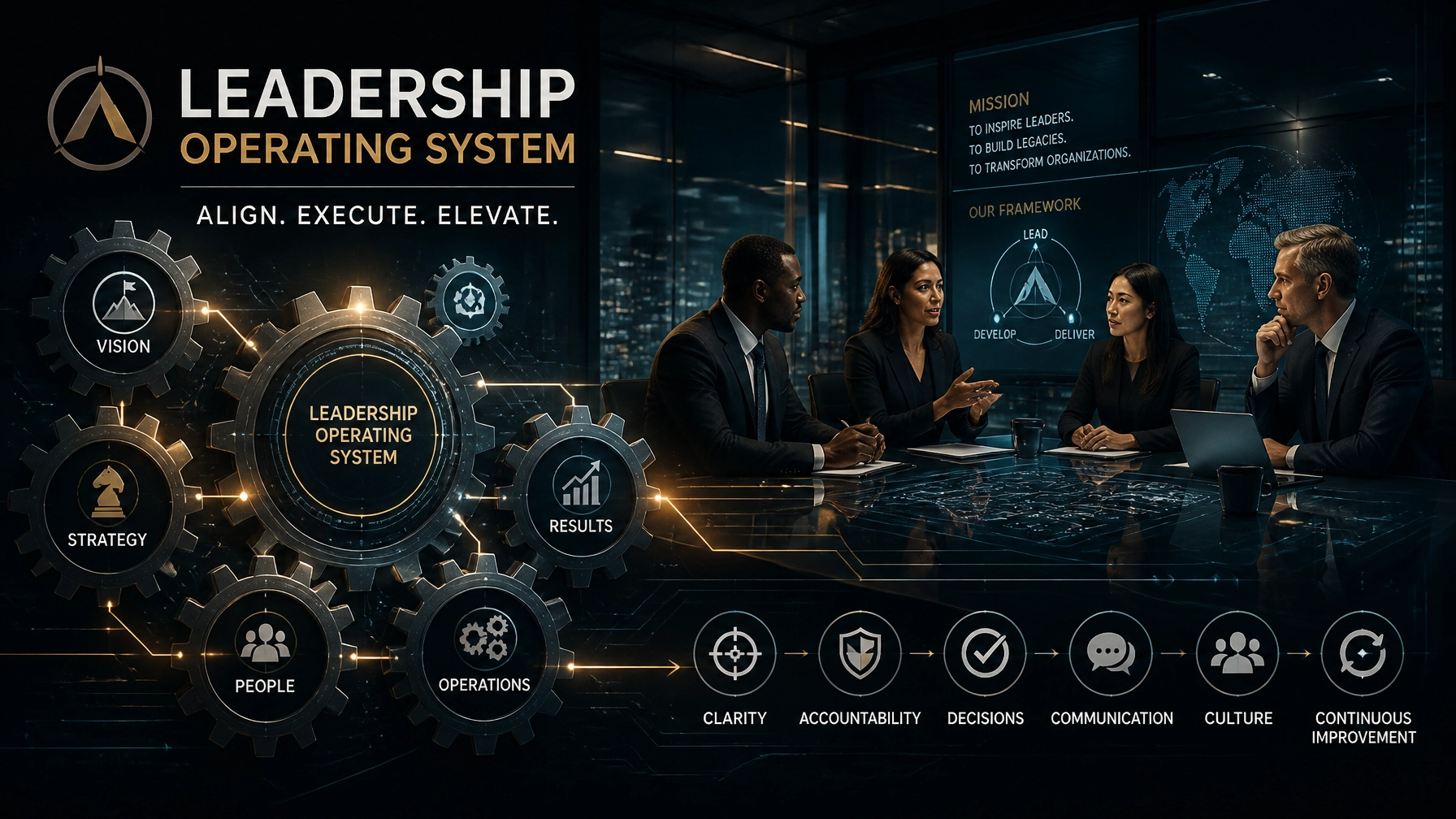
In the high-stakes world of executive leadership, "performance" is often treated as a nebulous quality: something you either have or you don't. Leaders spend millions on talent acquisition and "culture building" without ever addressing the underlying architecture that governs how their people actually work.
At Legacy Vanguard Scott Group (LVSG), we view leadership through a different lens. As a veteran-owned firm, we understand that high performance isn't a personality trait; it is the output of a disciplined system. We call this the Leadership Operating System (Leader OS).
If your organization is currently grappling with persistent vacancies, stagnant growth, or a culture of "firefighting," the problem isn't your people. It’s your operating system: or the lack thereof.
The "Supervision Tax": The Hidden Cost of Chaos
Before we define the solution, we must identify the parasite. In many organizations, there is a hidden "Supervision Tax": a persistent drain on resources caused by the need for constant, manual oversight.
The Supervision Tax manifests as:
- Decision Bottlenecks: Leaders who are required to approve every minor action because their "Commander's Intent" (Strategic Alignment) was never clearly communicated.
- Redundant Meetings: Hours spent "getting on the same page" because the "Rhythm of Battle" (Operational Rhythm) is nonexistent.
- Talent Attrition: Top-tier performers leaving because they are micromanaged by leaders who lack a structured framework for delegation.
When you lack a Leadership Operating System, your leaders are forced to spend 80% of their time supervising "the how" rather than strategizing "the why." This inefficiency is a direct hit to your bottom line and a barrier to building a lasting legacy.

What Exactly is a Leadership Operating System?
A Leadership Operating System is a repeatable framework that standardizes how leadership happens within an organization. It is the "software" that runs on your human "hardware." It answers the critical questions that often go unasked:
- How do we set and communicate direction?
- How do we run meetings that actually drive results?
- How do we make decisions at speed?
- How do we hold individuals accountable without micromanaging?
Without a standardized OS, every manager leads differently. This inconsistency creates friction, confusion, and eventually, a breakdown in organizational stability. By implementing a customized LOS, you transition from person-dependent performance to system-dependent performance.
Mission Command: The DNA of High-Performance Teams
At LVSG, we lean heavily on the military principle of Mission Command (Strategic Empowerment & Intent-Based Leadership).
In a combat environment, a commander cannot be everywhere at once. Success depends on the ability of every individual to exercise "Disciplined Initiative" (Autonomous Problem-Solving) based on a clear understanding of the "Commander’s Intent" (Strategic Alignment).
Civilian Translation Layer:
- Commander’s Intent → Strategic Alignment: A clear statement of the "why" and the "what" that allows teams to decide the "how" independently.
- AAR (After Action Review) → Strategic Debrief: A structured process for analyzing what happened, why it happened, and how to improve.
- Rhythm of Battle → Operational Rhythm: The predictable cadence of meetings, reports, and checkpoints that keeps the organization moving.
When you apply Mission Command (Strategic Empowerment) to a corporate setting, you empower your mid-level managers to lead with confidence. You give them the guardrails they need to take "Prudent Risk" (Calculated Business Decisions) without waiting for a green light from the C-suite.
The Core Components of an Elite Leadership OS
To harden your culture and elevate performance, your Leadership OS must be built on four foundational pillars:
1. Strategic Alignment (Commander’s Intent)
High-performance teams do not wait for instructions. They move toward an objective because the leader has clearly defined the desired end state. In our Executive Leadership Coaching, we teach leaders how to articulate a vision so clearly that their presence is no longer required for the team to execute.
2. Operational Rhythm (Rhythm of Battle)
Chaos thrives in the absence of structure. An elite OS establishes a "cadence of accountability." This isn't about more meetings; it's about the right meetings. Weekly huddles focus on blockers and "Strategic Debriefs" (AARs) focus on learning from failures and successes alike. This rhythm creates momentum and ensures that no one is "drifting" off-course.
3. Decision Rights & Guardrails
One of the primary causes of the "Supervision Tax" is unclear decision rights. Your OS must explicitly define who has the authority to make specific calls. By establishing clear guardrails: policy, ethics, and service standards: you give your team the freedom to act within those boundaries.
4. Measurable Behavior Change
A Leadership OS isn't just a document; it’s an "Operating System for Behavior." We use data-driven insights and auditable staffing engines to ensure that the leadership habits being formed are leading to tangible outcomes: reduced vacancies, higher retention, and improved service quality.
The LVSG Difference: Linking Leadership to Staffing
Most consulting firms offer either "soft" leadership coaching or "hard" recruitment services. Legacy Vanguard Scott Group is different. We recognize that these two functions are inextricably linked.
If you have a broken Leadership Operating System, your "Strategic Recruiting" (Talent Acquisition) efforts will fail. You will hire top talent only to watch them wither in a culture of micromanagement or leave due to a lack of clarity.
Our dual-service model: linking coaching with a structured, auditable staffing engine: ensures that your new hires are being onboarded into a high-performance environment designed for their success. We don't just fill seats; we harden the culture so those seats stay filled.
The Path to Legacy
Choosing to implement a Leadership Operating System is an act of discipline. It requires a shift from "leading by feeling" to "leading by design." It is the difference between a company that survives and an organization that leaves a legacy.
Whether you are a veteran-owned small business or a large public-sector employer, the truth remains the same: your success is limited by the quality of your operating system.
We’re also building something new behind the scenes: our Leadership OS Ebook series, launching in June. Stay tuned as we deep-dive into the systems, structures, and leadership habits that help organizations strengthen culture, sharpen execution, and create lasting impact.
Are you ready to stop paying the "Supervision Tax"? Are you ready to empower your team to lead with the precision of a high-performance military unit?
Who’s ready to harden their culture and build a legacy? 🔥 🌐 https://www.legacyvanguardscott.com/ 🌐
Leave a Reply