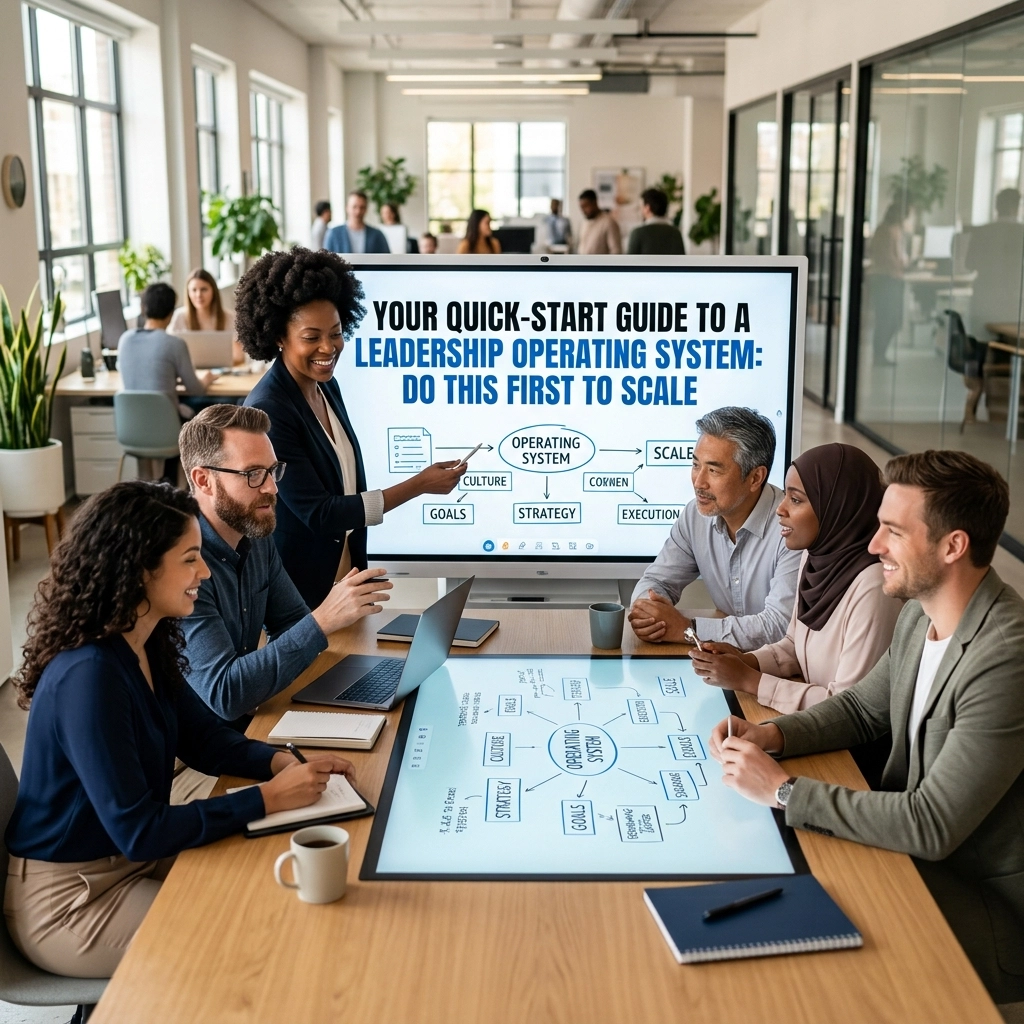
In the high-stakes environment of business growth, most organizations fail not because of a lack of vision, but due to a lack of a cohesive "engine" to drive that vision forward. As a company moves beyond its initial startup phase, the informal handshakes and "tribal knowledge" that once sufficed become liabilities. To scale effectively, you must transition from accidental leadership to an intentional Leadership Operating System (LOS).
A Leadership Operating System is the intentional design of how you lead, manage, and scale your organization. It is the framework that ensures your mission is translated into measurable behavior change: creating a culture of accountability and high performance. At Legacy Vanguard Scott Group, we view this through the lens of military-grade discipline: translating the "Rhythm of Battle" into a sustainable "Operational Rhythm" for civilian success.
If you are ready to stop putting out fires and start building a legacy, this is your quick-start guide to the foundational framework of a LOS.
The Foundation: Commander’s Intent (Strategic Alignment)
The most critical failure in scaling is the "dilution of intent." As an organization grows, the distance between the CEO’s vision and the front-line execution increases. To prevent this, you must master Commander’s Intent (Strategic Alignment).
In military operations, Commander’s Intent is a clear, concise expression of the purpose of the operation and the desired end state. In the corporate world, this translates to Strategic Alignment: the non-negotiable definition of what "winning" looks like for your organization.
Before you can scale, your leadership team must define:
- The Mission: Why do we exist today?
- The Vision: Where are we going in three to five years?
- The End State: What does the landscape look like once we succeed?
Without this clarity, your team will optimize for the wrong goals. Establishing Strategic Alignment ensures that even when communication breaks down, every team member understands the overarching objective and can exercise initiative to achieve it. This is the first step to elevating your leadership from micro-management to mission-driven oversight.

Phase 1: Establish the Battle Rhythm (Operational Cadence)
Once the destination is clear, you need a heartbeat to keep the organization moving. In the military, this is known as the Battle Rhythm; in business, we call this the Operational Cadence.
An Operational Cadence is a synchronized sequence of meetings, reports, and checkpoints that ensures information flows vertically and horizontally. Most businesses suffer from "meeting fatigue" because their meetings lack a specific purpose within an operating system. A true LOS utilizes a tiered approach to communication:
- The Daily Stand-up (Daily Huddle): A 15-minute high-impact session focused on immediate obstacles and the next 24 hours.
- The Weekly Sync (Operational Review): A focused look at the week’s Key Performance Indicators (KPIs) and resource allocation.
- The Monthly Deep-Dive (Strategic Review): A time to step back from the "tactical" and evaluate progress toward long-term milestones.
- The Quarterly Off-site (Strategic Pivot): A formal session to realign the Commander’s Intent with market realities.
By hardening this cadence, you eliminate the need for "urgent" ad-hoc meetings that disrupt deep work. This structure creates a predictable environment where leadership can empower their teams to perform without constant supervision.
Phase 2: Standardizing the Response (SOPs and Decision Rights)
Scalability is impossible if the founder or CEO is the only person authorized to make a decision. To scale, you must distribute power. This requires two things: Standard Operating Procedures (SOPs) and clearly defined Decision Rights.
In tactical environments, "SOPs" are life-saving protocols. In business, they are the "Manual of Arms" for your corporate operations. SOPs ensure that "The Legacy Vanguard Scott Group way" is executed with consistency, regardless of who is in the seat.
However, SOPs are only half the battle. You must also define Decision Rights (Authority Matrices). You must explicitly state who has the authority to spend money, hire talent, and change processes. By codifying these rights, you remove bottlenecks and ignite a sense of ownership across your leadership pipeline. When people know exactly where their authority begins and ends, they move faster and with more confidence.

Phase 3: The After Action Review (Strategic Debrief)
A Leadership Operating System is not a static document; it is a living entity that must be refined through constant feedback. The most powerful tool for this is the After Action Review (Strategic Debrief).
An AAR is a professional discussion of an event, focused on performance standards, that allows a team to discover for themselves what happened, why it happened, and how to sustain strengths and improve on weaknesses. To implement this as a "quick win" in your LOS, follow this four-question framework after every major project or milestone:
- What was supposed to happen? (Review the original Strategic Alignment)
- What actually happened? (Identify the ground truth)
- Why did it happen? (Root cause analysis: focus on the "what," not the "who")
- What will we do differently next time? (Concrete action items for behavior change)
Integrating the Strategic Debrief into your culture transforms failures into tuition. It removes the fear of blame and replaces it with a relentless pursuit of excellence. This commitment to continuous improvement is what separates "good" companies from those building a lasting legacy.
Phase 4: Strengthening the Pipeline (Strategic Recruiting)
Your Leadership Operating System is only as strong as the people who operate it. As you begin to scale, you will quickly realize that the team that got you to $1M may not be the team that gets you to $10M. This is where Strategic Recruiting and Placement becomes a core component of your LOS.
You must view recruiting not as a "reactive" HR function, but as a "proactive" leadership function. This involves:
- Culture Alignment: Identifying candidates who share your mission-driven mindset.
- Capability Assessment: Ensuring new hires have the technical discipline to operate within your system.
- Leadership Development: Training your current managers to become the next generation of executives through personalized 1:1 coaching.
A veteran-led approach to HR focuses on "Force Multipliers": individuals whose presence makes everyone around them better. By integrating a strategic recruiting solution into your LOS, you ensure that your growth is supported by top-tier talent that is already aligned with your operating principles.

Execution: Do This First
If you are overwhelmed by the prospect of building a full LOS, start with one thing: The Operational Rhythm.
Establish your weekly sync. Make it non-negotiable. Use that time to define your Commander’s Intent for the month. Once that rhythm is established, the other pieces: the SOPs, the AARs, and the Decision Rights: will naturally fall into place because the system demands them.
Scaling a business requires more than just "working harder." it requires the discipline to build a system that can work without you. It requires a commitment to high standards, absolute accountability, and a mission-driven culture.
Building a Leadership Operating System is the ultimate act of leadership. It is how you transition from being a "boss" to becoming a builder of a legacy. This is not a quick fix: it is a hardening of your corporate DNA to ensure long-term success and breakthrough performance.
Are you ready to move from chaos to clarity? The framework is ready. The discipline is required. Let’s get to work.
Who’s ready to harden their culture and build a legacy? 🔥 🌐 https://www.legacyvanguardscott.com/ 🌐
Leave a Reply