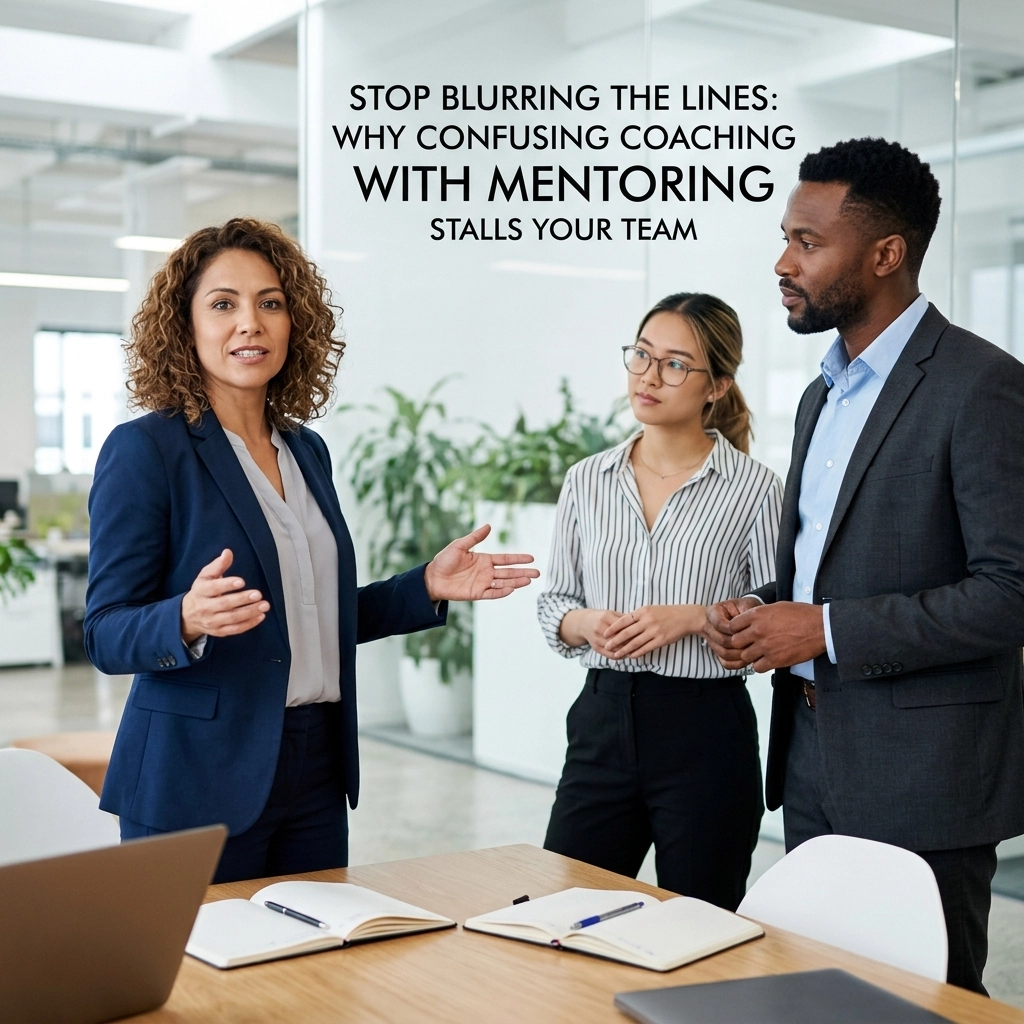
Fire Mission! For those of us from the old Army days in the Artillery, those two words meant one thing: immediate action, precision, and a total shift in focus. In the corporate world, I’m calling a Fire Mission (Immediate Tasking) on a habit that is quietly sabotaging your team’s growth.
As a leader, your most valuable asset isn’t your budget or your tech stack: it’s your influence. But if you don't know how to deploy that influence correctly, you end up stalling the very people you’re trying to accelerate. The biggest culprit? Treating coaching and mentoring as interchangeable terms.
They aren’t the same. They require different skill sets, different mindsets, and they yield entirely different results. If you get this wrong, you aren't just being a "helpful boss": you’re accidentally creating a bottleneck.
The Trap of the Mentoring Default
It is incredibly easy to default to mentoring. Why? Because it feels productive. It feels like you’re being the "Veteran" in the room. You share what worked for you ten years ago, offer your perspective on a current roadblock, and try to shorten the road for someone else by giving them the map you used.
In the military, we call this providing the "OPORD" (Operations Order). You’re telling them the what, the how, and the when. In a business context, this is Strategic Guidance. It’s valuable, but it has a shelf life.
The problem is that not everyone needs your roadmap. Sometimes, providing your answer robs your high-performers of the opportunity to build their own. When you give them the solution, you’re training them to come back to you for the next one. You are effectively building a follower, not a leader. You’re building a culture of dependency instead of a culture of ownership.

Coaching: The "Executive Armor" Approach
When we talk about executive coaching for leaders, we aren't talking about "giving advice." Real coaching is about sharpening the individual’s judgment. It’s about building their Command Presence (Executive Presence) and their ability to operate under pressure without looking at you for the "all-clear."
At Legacy Vanguard Scott Group, we view coaching as the "Executive Armor" approach. You are helping your team members forge their own mental reps so that when they hit a high-stakes situation, they have the internal structure to survive and thrive.
The difference is simple:
- Mentoring builds a follower who knows how to do what you did.
- Coaching builds a leader who knows how to solve problems you haven’t even seen yet.
The Decision Matrix: Read the Moment
To be an effective leader, you must move between these roles with intention. You can't just react; you have to evaluate the individual and the situation before you speak. Think of this as your "Rhythm of Battle" (Operational Rhythm) for talent development.
When to Use Coaching (Sharpening the Blade)
Use coaching when you want to build long-term capability and high-stakes ownership. This is the heart of leadership development consulting.
- When they see the options but lack the decisiveness to choose: If a direct report comes to you with three different paths and asks, "Which one should I take?": don't answer. You aren’t there to pick for them; you are there to sharpen their judgment. Ask them, "What is the risk profile of Option A versus Option C?" Make them defend their logic.
- When the capability is present but the confidence is missing: Sometimes your team has the skills, but they’re playing it safe because they’re afraid to fail. Coaching builds the mental reps required for ownership. If you tell them what to do, you’re shielding them from the growth that comes with being wrong.
- When you need them to own the outcome: This is critical. If they use your answer, they are effectively borrowing your accountability. If the project fails, it’s your fault because they just did what you said. If they find their own way and own the result, they internalize the victory (or the lesson).

When to Use Mentoring (The Veteran Perspective)
Mentoring has its place, particularly when the terrain is truly uncharted for the person in front of you.
- When the focus is long-term trajectory rather than the immediate move: If you’re discussing career mapping, legacy, or where they want to be in five years, put on your mentor hat. This is about perspective and sharing the "scar tissue" you’ve earned over the years.
- When they are navigating "uncharted terrain": If your team is facing a market shift or a technical obstacle they have literally never seen, your history provides the necessary context. Don't let them wander into a minefield just for the "lesson." Use your history to prevent preventable casualties.
- When technical or institutional knowledge is the only way forward: Sometimes there is an "internal OS" (Operating System) within a company that only a veteran knows. In these cases, sharing the shortcut is the right move for the mission.
Audit Your Leadership: The Strategic Debrief
If you want to know if you’re actually developing your team or just giving directions, you need to conduct an AAR (After Action Review/Strategic Debrief) on your own leadership style.
Take a look at your last five conversations with your direct reports. Go through your notes or your memory of those meetings.
- Did you provide a solution, or did you provide the space for them to develop one?
- Did you talk more than you listened?
- Did they leave the room with your "to-do" list, or did they leave with a clearer understanding of their own decision-making process?
If you find that you are the primary problem-solver for your team, you have successfully stalled your organization’s growth. You are the bottleneck. You are the single point of failure.

Strengthening the Vanguard
At Legacy Vanguard Scott Group, we specialize in helping organizations move past these plateaus. Whether it’s through our Executive Coaching or our broader Consulting Services, we focus on hardening your leadership culture.
The goal isn't just to get through the current quarter; it's to build a legacy of leaders who can operate with Strategic Alignment (Commander’s Intent) even when you aren't in the room.
Stop blurring the lines. Stop giving your roadmap to people who need to be building their own. Start coaching for judgment and mentoring for perspective. That is how you turn a group of high-performers into a truly elite team.

Which is your default today? Are you building leaders, or are you just giving directions? The answer to that question determines whether your team stays stalled or starts to soar.
Who’s ready to harden their culture and build a legacy? 🔥 🌐 https://www.legacyvanguardscott.com/ 🌐
Leave a Reply