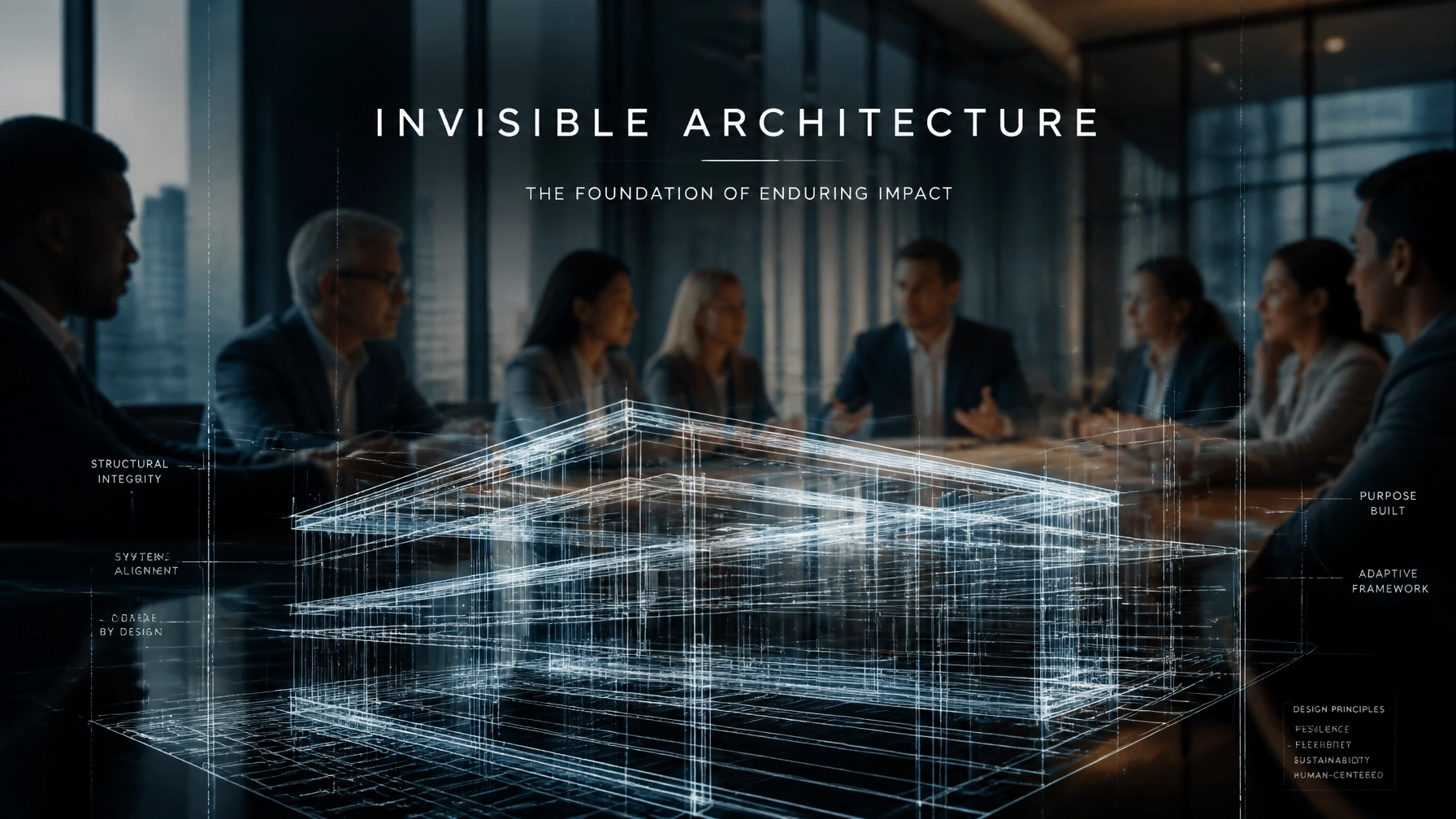
When you walk into a skyscraper, you admire the glass facade, the marble lobby, and the sweeping views from the penthouse. You don’t walk in and celebrate the foundation depth or the load-bearing integrity of the steel beams. Yet, without that Invisible Architecture, the building is nothing more than a precarious stack of materials waiting for a structural failure.
In the world of high-stakes business, your culture operates the same way. Most leaders focus on the "facade": the office perks, the mission statement on the wall, or the annual retreat. While these have value, they are secondary. The true strength of an organization lies in its governance: the unwritten and written systems of decision rights, data flow, and process hand-offs.
At Legacy Vanguard Scott Group, we specialize in leadership development consulting that goes beneath the surface. We understand that volume does not equal value. The highest-value work in any organization is often the least visible: it is the disciplined engineering of how decisions are made.
The Load-Bearing Walls: Decision Rights as Governance
Nobody throws a party for a well-written decision rights framework. However, the organizations that "nail the invisible stuff" are the ones that scale with velocity and precision.
In military terms, we refer to this as Commander’s Intent (Strategic Alignment). When every member of the unit understands the end state of the mission, they can make independent decisions that align with the overall goal without waiting for a direct order. In the corporate sector, this translates to clear Strategic Alignment. Without it, your executive leadership development programs will fail to produce results because your leaders won't know where their authority begins and ends.
Effective governance requires defining four critical categories of authority:
- Formal Approval: Decisions that require a binding vote or executive sign-off (e.g., mergers, major capital expenditures).
- Consult Before Action: Management holds the decision rights but must shape their thinking through stakeholder input first.
- Delegated with Reporting: The team acts independently and reports the outcome to ensure oversight.
- Fully Delegated: Day-to-day operational choices that require no routine reporting.
When these boundaries are blurred, the "Invisible Architecture" begins to crack. Decision-making slows, accountability diffuses, and your best talent becomes paralyzed by a lack of clarity.

Hardening the Culture: Moving Beyond "Visible Wins"
Early wins buy patience. When a new leader takes the helm, they often chase visible victories: a new marketing campaign, a high-profile hire, or a revamped website. While these can ignite momentum, they are different from structural transformation.
Improving organizational culture isn't about looking good; it's about being strong. True cultural hardening happens when you establish a rigorous Rhythm of Battle (Operational Rhythm). This is the cadence of meetings, data reviews, and strategic touchpoints that ensure the organization is moving in unison.
If your "Invisible Architecture" is weak, your culture will be reactive. You will find yourself constantly fighting fires rather than executing strategy. By implementing a structured HR advisory service model, you move from a culture of personality to a culture of process. This ensures that your legacy isn't tied to a single individual, but to a system that produces top-tier results consistently.
The Strategic Debrief: Learning from the Field
In the veteran-owned tradition of Legacy Vanguard Scott Group, we lean heavily on the AAR (After Action Review). In the civilian world, we call this a Strategic Debrief.
High-performing teams do not move from one project to the next without a disciplined analysis of what happened, why it happened, and how to improve. This process is a cornerstone of our executive coaching.
A Strategic Debrief focuses on:
- Performance vs. Plan: Did we achieve the intended outcome?
- Measurable Behavior Change: How did our leadership actions impact the team's execution?
- Process Gaps: Where did the "Invisible Architecture" fail us?
By normalizing the Strategic Debrief, you foster a culture of accountability and continuous improvement. You empower your team to "own the outcome" rather than "hide the error."

Scaling with Integrity
As organizations grow, the complexity of their "Invisible Architecture" increases exponentially. What worked for a team of ten will crumble for a team of two hundred.
To scale successfully, you must:
- Standardize the "Golden Path": Create repeatable design patterns for common decisions.
- Embed Guardrails: Use automated processes and clear policies so that governance is felt, not managed.
- Prioritize Unity of Effort (Cross-functional Collaboration): Ensure that different departments aren't operating in silos, but are aligned toward a singular mission.
At Legacy Vanguard Scott Group, we provide the dual-service model: linking executive coaching with a structured staffing engine: to help you build this foundation. We help organizations stabilize staffing and strengthen leadership, protecting your service quality and reducing the costs of lost productivity.
Building Your Legacy
The most enduring organizations are not built on flashy facades; they are built on a bedrock of disciplined governance and clear decision rights. They recognize that the work done in the shadows: the "Invisible Architecture": is what allows them to stand tall in the light.
Are you ready to stop chasing visible wins and start building a foundation that lasts? It requires a commitment to rigor, a dedication to clarity, and a willingness to lead with confidence.

Legacy is not what you do today; it is what remains when you are gone. Strengthen your architecture, empower your people, and achieve breakthrough performance.
Who’s ready to harden their culture and build a legacy? 🔥 🌐 https://www.legacyvanguardscott.com/ 🌐
Leave a Reply