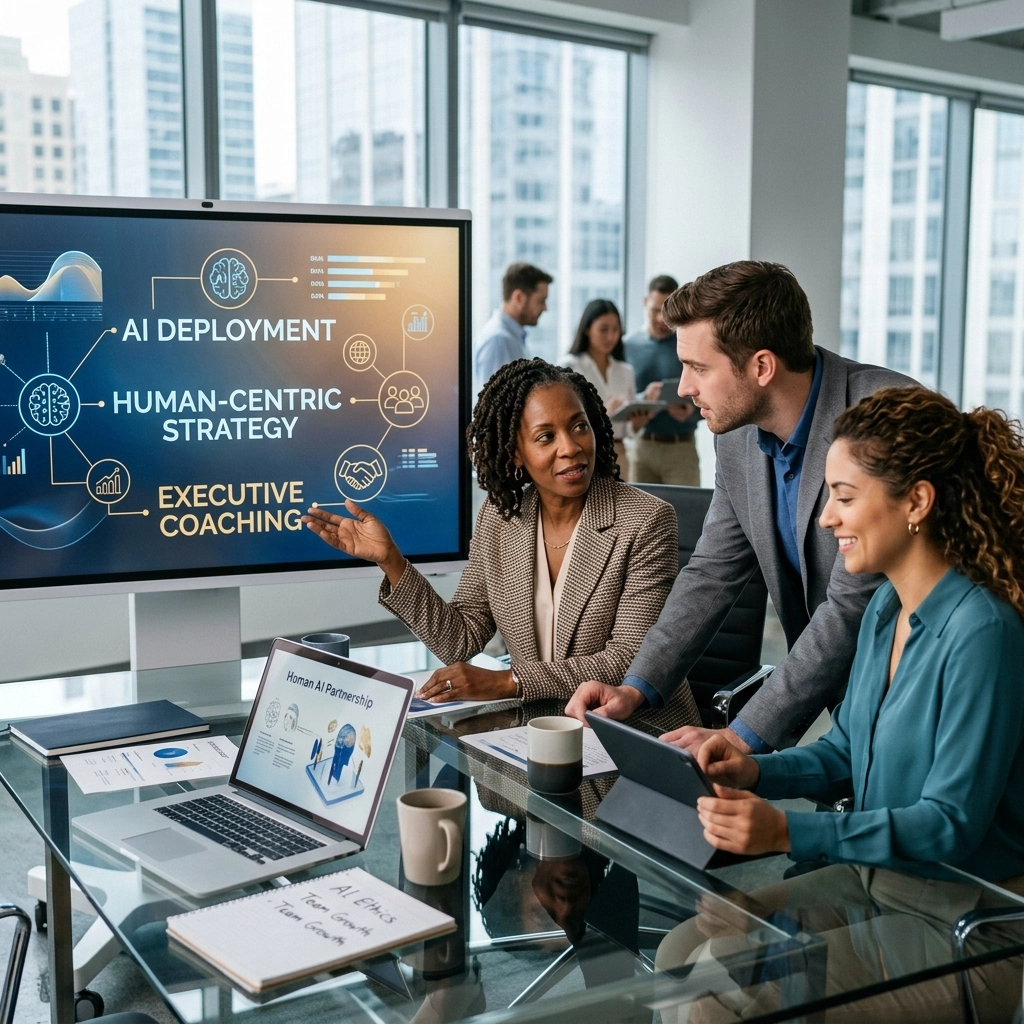
The year 2026 has marked a definitive shift in the corporate landscape. The initial frenzy of "AI at all costs" has been replaced by a sobering realization: technology is a powerful tool, but it lacks the soul of leadership. At Legacy Vanguard Scott Group, we have observed that the organizations achieving true breakthrough performance are not those with the fastest processors, but those with the most disciplined leaders.
Deploying Artificial Intelligence without a foundation of human-centric executive coaching is like handing a high-performance jet to someone without flight training: you might get off the ground, but the landing will be catastrophic. To truly stabilize your leadership and ignite growth, you must bridge the gap between silicon and spirit. This is where human-centric coaching becomes the ultimate Strategic Catalyst (Force Multiplier).
The Commander’s Intent (Strategic Alignment) in the Age of Algorithms
In military operations, the Commander’s Intent (Strategic Alignment) is the heart of every mission. It provides a clear picture of the desired end state, allowing subordinates to exercise initiative even when communication breaks down. In the civilian sector, AI often creates a "communication breakdown" by automating processes so quickly that the "why" behind the work gets lost.
When you deploy AI, the machine follows logic, but it does not understand intent. Human-centric executive coaching ensures that leaders remain the masters of the Strategic Alignment (Commander’s Intent). By refining a leader's ability to articulate clear, mission-driven objectives, we ensure that AI tools are configured to serve the long-term legacy of the firm, rather than just chasing short-term efficiency gains.
Coaching forces an executive to step back from the "how" of technology and re-engage with the "what" and the "who." This discipline is what prevents an organization from drifting off course during a digital transformation. It creates an Operating System of clarity that no algorithm can replicate.

Bridging the Adaptability Gap: The 30% Advantage
Statistics from recent industry shifts show a startling trend: organizations that integrate targeted executive coaching into their tech deployments see 30% faster adoption rates across their departments. Why? Because technology adoption is rarely a technical hurdle: it is a psychological one.
The "Adaptability Gap" is the space between the speed of technological evolution and the speed of human behavior change. Executive coaching acts as the bridge. It empowers leaders to identify and mitigate cultural resistance before it hardens into institutional paralysis.
Through a disciplined Operational Rhythm (Rhythm of Battle): a consistent cadence of check-ins and strategic adjustments: coaches help leaders navigate the emotional landscape of their teams. When employees see their leaders operating with confidence and human empathy while utilizing AI, the fear of replacement evaporates. It is replaced by a sense of empowerment. We don’t just deploy tools; we strengthen the people who use them.
Acting as the Ethical Guardian
AI is a mirror, not a mentor. It reflects the data it is fed, often including the biases and ethical shortcuts inherent in that data. This is why the modern executive must serve as an Ethical Guardian.
In our high-stakes coaching sessions, we prioritize the development of an "Ethical Moat." This involves:
- Decision Rights: Clearly defining where the machine ends and the human begins.
- Accountability Frameworks: Ensuring that even when an algorithm makes a suggestion, a human owns the outcome.
- Value-Aligned Deployment: Ensuring AI usage reflects the core values and "Legacy" the company intends to leave behind.
Coaching provides the safe space: a Strategic Debrief (After-Action Review) environment: where leaders can pressure-test their AI strategies against their personal and organizational ethics. Without this human-centric filter, AI deployment risks damaging the trust you have spent decades building with your clients and employees.
High-Touch in a High-Tech World: The HEARTH Model
To stabilize leadership during rapid transitions, we utilize frameworks that balance rigor with humanity. One such approach is the HEARTH model: focusing on Ethics, Accountability, and Human-centered values. In a world of cold data, "High-Touch" leadership becomes a premium service.
AI cannot pick up on the subtle non-verbal cues of a demoralized team. It cannot sense the tension in a boardroom or the unspoken hesitation of a high-potential recruit. Executive coaching sharpens these "soft" skills into "hard" assets. By focusing on human-centricity, we help leaders develop a Frontline Presence (Boots on the Ground) that inspires loyalty.
When you invest in coaching, you are not just improving a single leader; you are hardening the culture of the entire organization. You are building a leadership pipeline that is resilient to the next wave of disruption, whether it be AI, economic shifts, or industry-wide staffing gaps.

Transforming AI from a Threat to a Strategic Catalyst
The narrative around AI is often one of replacement. However, at Legacy Vanguard Scott Group, we view AI as a Strategic Catalyst (Force Multiplier). When an executive is coached to leverage their unique human strengths: vision, empathy, and complex moral judgment: they can use AI to automate the mundane and focus on the Business Critical (Mission Essential).
This shift in perspective is transformative. Imagine a healthcare leadership team that uses AI to handle logistical scheduling but uses the time saved to engage in 1:1 mentorship and patient-centered culture building. That is the power of a human-centric approach. It doesn't just make the business faster; it makes the business better.
We help leaders move through our tiered growth models: from Elevate to Apex: by integrating technology as an enhancement to their existing strengths. This disciplined approach ensures that as your "tech stack" grows, your "leadership stack" grows even faster.
The Strategic Debrief (After-Action Review): Constant Iteration
A key component of our coaching methodology is the Strategic Debrief (After-Action Review). In the context of AI deployment, this means regularly stepping away from the dashboards to evaluate the human impact.
- What was supposed to happen? (Reviewing the Strategic Alignment).
- What actually happened? (Analyzing the data and the team's morale).
- Why was there a difference? (Identifying the "Adaptability Gap").
- What will we do differently next time? (Hardening the process).
This level of discipline ensures that your AI deployment is never static. It is a living, breathing part of your organization that evolves under the watchful eye of a prepared leader.

Why Human-Centric Coaching is the Only Way Forward
The organizations that will dominate the next decade are not those with the most advanced code, but those with the most advanced cultures. Technology is a commodity; leadership is a legacy.
Human-centric executive coaching changes the way you deploy AI by:
- Providing Strategic Clarity: Ensuring the tools serve the mission, not the other way around.
- Increasing Resilience: Preparing the workforce for the emotional toll of constant change.
- Ensuring Accountability: Maintaining a human-in-the-loop for every Business Critical (Mission Essential) decision.
- Accelerating Results: Leveraging the 30% adoption advantage through clear communication and trust.
At Legacy Vanguard Scott Group, we specialize in this intersection of discipline and development. We are here to help you stabilize your leadership, harden your culture, and ensure that your deployment of AI is a step toward a lasting legacy, rather than a slide into technical debt.
The future is automated, but leadership must remain authentic. Are you prepared to lead the machine, or will you let the machine lead you?
Who’s ready to harden their culture and build a legacy? 🔥 🌐 https://www.legacyvanguardscott.com/ 🌐
Leave a Reply