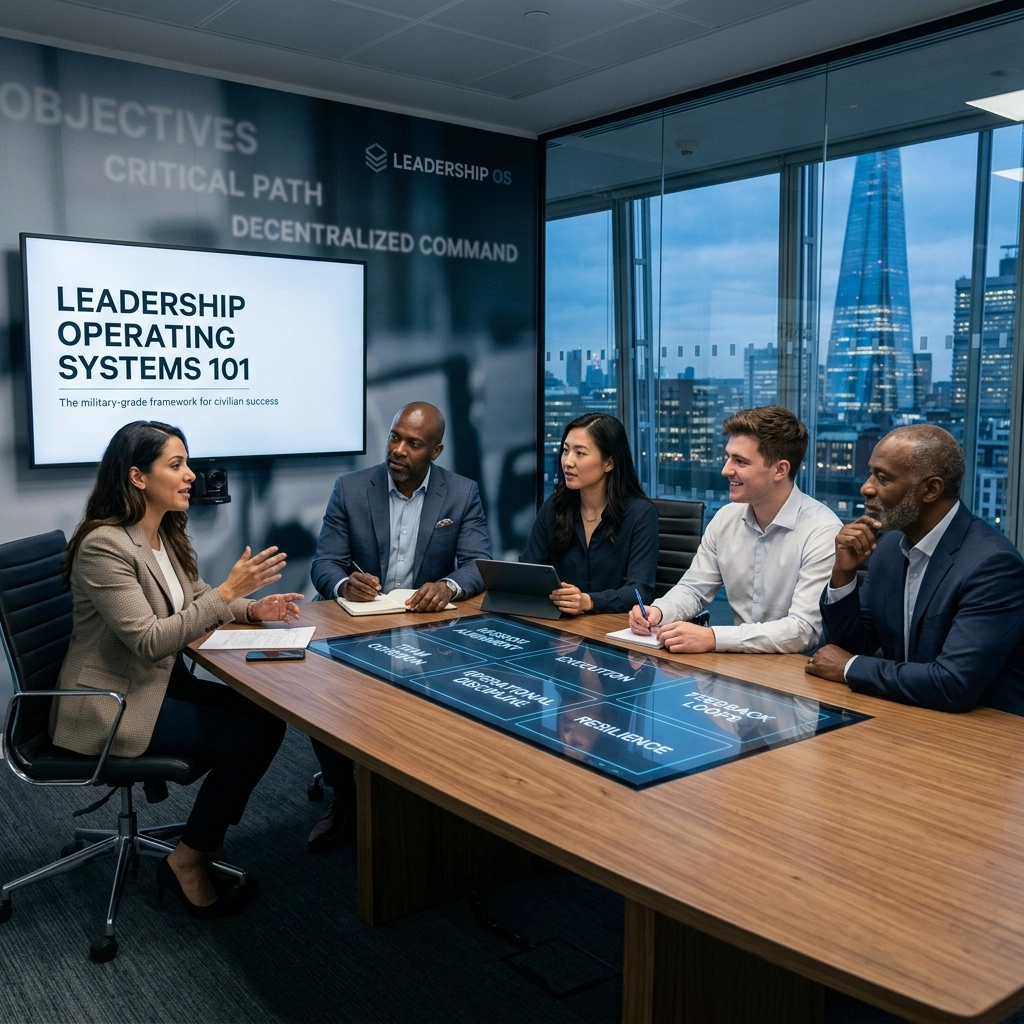
Let’s be honest for a second: most leadership teams are running on "vibe-based" management. You know the drill, everyone shows up to meetings, there’s a lot of talking, a few fires get put out, and everyone leaves feeling "busy" but not necessarily productive. It feels like you’re constantly reacting to the environment instead of shaping it.
If your organization feels like a collection of talented individuals pulling in slightly different directions, you don't have a people problem. You have an Operating System problem.
In the military, we don’t leave leadership to chance or personality. We use a Leadership Operating System (LOS), a battle-tested framework designed to ensure that even in the highest-stakes environments, the mission gets accomplished, people stay accountable, and the culture remains unbreakable.
At Legacy Vanguard Scott Group, we’ve taken these high-stakes principles and translated them for the civilian sector. This isn't just about "discipline" in the abstract; it's about installing a functional, repeatable system that empowers your team to win.
What Exactly is a Leadership Operating System?
Think of your favorite smartphone. It has hardware (the phone itself) and software (the apps). But without an Operating System (iOS or Android), those two things can’t talk to each other. The hardware sits idle, and the apps are useless.
In your business, your "hardware" is your infrastructure, your office, and your tech stack. Your "apps" are your people and their individual skills. The Leadership Operating System is the invisible layer that connects them. It’s the set of behaviors, routines, decision patterns, and expectations that govern how work actually gets done.
When you invest in executive leadership development programs, you aren’t just teaching people how to be "nicer" managers. You are teaching them how to run the OS.

The Core Components of a Battle-Tested LOS
To transition from a "reactive" team to a "proactive" powerhouse, your LOS needs three specific pillars. We call this the "Civilian Translation Layer," where we take the rigor of the field and apply it to the boardroom.
1. Strategic Alignment (Commander’s Intent)
In a combat environment, things change the second the first shot is fired. If a unit only knows a rigid plan, they fail when the plan falls apart. That’s why we use Commander’s Intent (Strategic Alignment).
Strategic Alignment is a clear, concise statement of what "success" looks like, minus the micromanagement of how to get there. When a leader provides Strategic Alignment, they are telling their team: "This is the end state we need to achieve, and this is why it matters."
In the civilian world, this means your team knows exactly what the goal is, even if you aren’t in the room. It empowers them to make decisions on the fly because they know the "North Star" of the project. If your team is constantly asking you for permission on small tasks, your Strategic Alignment is broken.
2. Operational Rhythm (Rhythm of Battle)
In the military, we have a Rhythm of Battle (Operational Rhythm). This isn't just a calendar; it's a heartbeat. It’s the scheduled cadence of briefings, updates, and decision points that ensures information flows where it needs to go.
Most civilian companies have "meeting fatigue" because their meetings have no rhythm. They are sporadic, lack clear agendas, and don’t result in decisions.
A true Operational Rhythm creates:
- Predictability: People know when and how information will be shared.
- Efficiency: Meetings are stripped of fluff and focused on "Decision Rights" (who has the authority to say 'yes').
- Momentum: Problems are caught early because the feedback loop is consistent.
3. Strategic Debriefs (After-Action Reviews – AAR)
This is the most neglected part of civilian leadership. In the military, we never finish a mission without an After-Action Review (Strategic Debrief). We ask: What was supposed to happen? What actually happened? Why was there a difference? What are we doing next time?
In business, we often finish a project and immediately sprint to the next one without looking back. This is how mistakes become "baked in" to your culture. A high-performing LOS requires a culture where the truth is more important than anyone's ego.

Why "Military-Grade" is the Key to Civilian Success
You might be thinking, "Rosella, my office isn't a war zone. Why do I need military-grade systems?"
It’s a fair question. The reason "military-grade" works so well in Leadership Development & HR Consulting is that military systems are designed for maximum clarity under maximum stress.
If a system can work when people are tired, stressed, and facing life-or-death stakes, it will absolutely crush it in a corporate environment. When you apply this level of rigor to your executive leadership development programs, you build a culture of "Extreme Accountability."
In this system, accountability isn't a punishment; it’s a standard. It means:
- Ownership: Everyone knows what they are responsible for.
- Reliability: You can trust that if a task is assigned, it will be executed to the standard.
- Transparency: When things go wrong (and they will), the focus is on fixing the system, not blaming the person.
Building Your Legacy Through Systems
At Legacy Vanguard Scott Group, we believe that true leadership isn't about being the smartest person in the room. It’s about building a system that makes everyone in the room smarter.
When you install a Leadership Operating System, you are essentially "future-proofing" your organization. You are moving away from a world where everything depends on you, the leader, and toward a world where the system drives the results. This is the difference between a business that survives and a business that leaves a legacy.
Whether you are looking for strategic recruiting to find the right people for your OS or you need to coach your existing executives to upgrade their leadership style, the goal remains the same: Precision, Accountability, and Results.

How to Start Installing Your LOS Today
You don't need to overhaul your entire company overnight. You can start small by implementing these "system updates":
- Audit Your Meetings: For every meeting on your calendar, ask: Is this part of our Operational Rhythm? Does it have a clear purpose? Does everyone know who has the Decision Rights?
- Define Your Intent: The next time you delegate a project, don't just give a to-do list. Give your "Commander’s Intent." Tell them what the successful end-state looks like and let them figure out the "how."
- Run a Debrief: After your next big deadline, sit the team down for 15 minutes. Ask the four AAR questions. Be honest. Be brief. Be better next time.
Leadership is a muscle, but the Operating System is the gym. Without the structure, the muscle never grows. It's time to stop winging it and start operating with the precision your mission deserves.
Who’s ready to harden their culture and build a legacy? 🔥 🌐 https://www.legacyvanguardscott.com/ 🌐

Final Thoughts: The High Standards of Success
Transitioning to a military-grade framework doesn't mean becoming a drill sergeant. It means becoming a professional who values the time, talent, and energy of their team enough to give them a system that actually works.
If you’re tired of the "Quiet Cracking" or the constant burnout that comes from systemic chaos, it’s time for an upgrade. Let’s build something that lasts.
If you want to dive deeper into how we tailor these systems for your specific industry, check out our Capabilities Statement or reach out to us directly. We’re here to help you lead with confidence and achieve breakthrough performance.
Leave a Reply